
Folklore ·
The Axeman of New Orleans
In the early 20th century, New Orleans pulsed with the rhythm of jazz, laughter, and late-night energy. But beneath the city’s vibrant surface, a shadow lingered—a figure who would come to embody terror in one of America...
By Rebecca "Madam Chronicler" Ryan
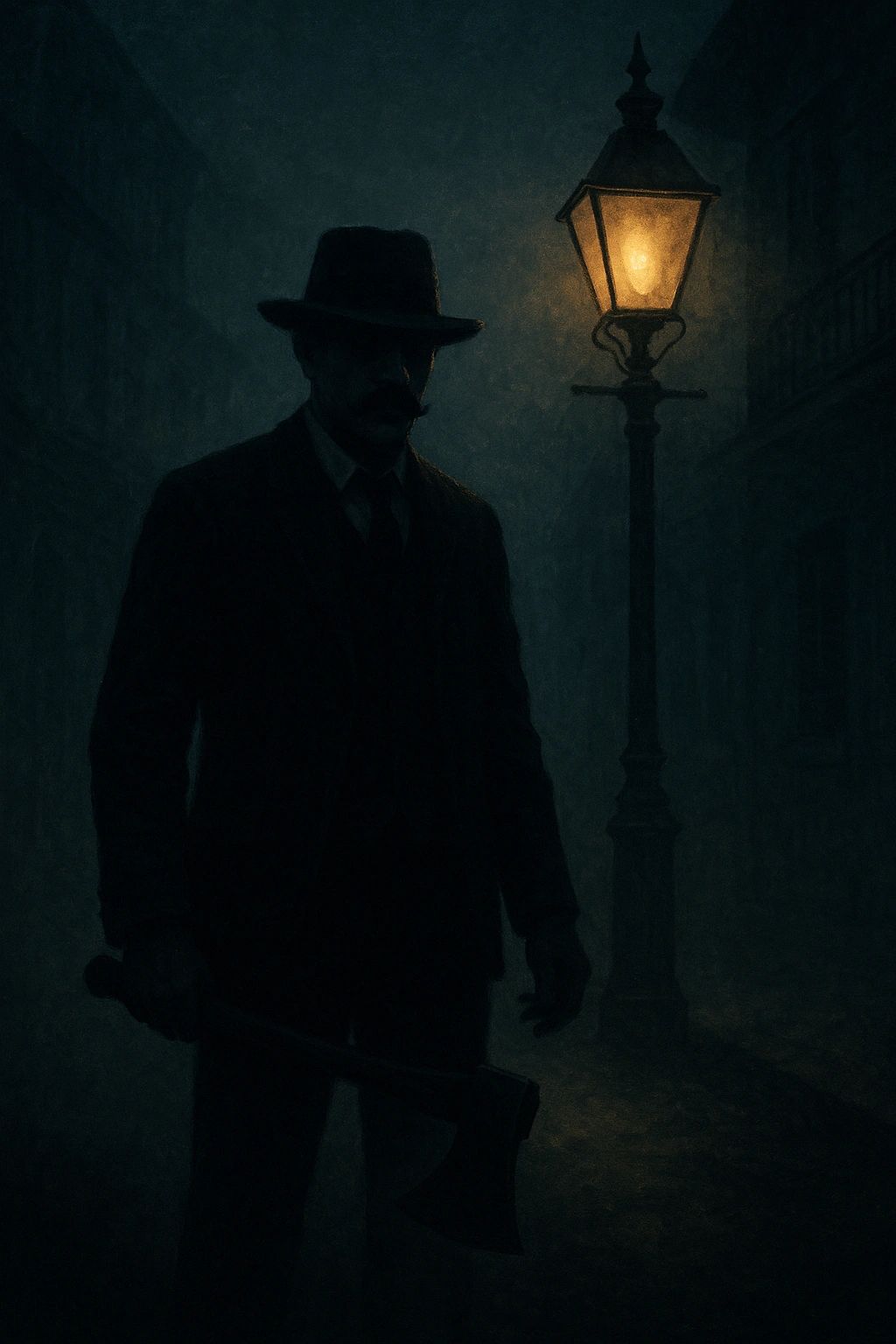
In the early 20th century, New Orleans pulsed with the rhythm of jazz, laughter, and late-night energy. But beneath the city’s vibrant surface, a shadow lingered—a figure who would come to embody terror in one of America’s most haunted cities. From 1918 to 1919, residents of the Crescent City lived in dread of an unknown assailant whose weapon of choice was an axe. He struck in the dead of night, leaving behind blood, mystery, and a strange connection to the city’s musical soul. His name would echo through history: The Axeman of New Orleans.
A City of Music and Mystery
New Orleans at the turn of the century was a melting pot of culture—French, Italian, African, and Creole traditions intertwined in a symphony of sound and spirit. Jazz was being born in smoky bars and brothels along Basin Street, and the city’s nightlife was thriving. But for all its vibrancy, the city was also a place of deep superstition, corruption, and poverty.
By 1918, World War I had just ended, the Spanish flu pandemic was ravaging the globe, and fear was already in the air. Then, as if summoned from some dark corner of the city’s soul, the Axeman appeared.
The First Strike: May 23, 1918
The first known attack occurred on May 23, 1918, when Joseph and Catherine Maggio, Italian grocers living on the corner of Upperline and Magnolia Streets, were found brutally assaulted in their bedroom. Joseph’s throat had been slit with a straight razor, and his skull crushed by an axe. Catherine was discovered lying beside him, her head nearly severed.
Their bedroom door had been chiseled open, and the murder weapon—Joseph’s own axe—was found discarded in the yard. Blood trailed through the house like a grisly map, leading investigators to a chilling realization: the killer had likely crept in while the couple slept and vanished silently into the night.
Despite the brutality, nothing had been stolen. The motive was unclear, and the police were baffled.
Fear Spreads Like Fire
The murder shocked New Orleans, but the city had seen violence before. Still, something about the Axeman’s method—his ability to enter homes without detection, his apparent preference for sleeping victims—felt different. Newspapers seized the story, calling him “The Fiend of New Orleans.”
Just over a month later, on June 27, 1918, the Axeman struck again. Louis Besumer and his mistress Harriet Lowe were attacked in their home above a grocery store on Dorgenois Street. Both were struck in the head with an axe while they slept, their door similarly chiseled open. Miraculously, both survived—at least at first.
When police questioned the injured Lowe, she accused Besumer of being a German spy, claiming the attack was part of a larger plot. The paranoia of World War I ran deep, and rumors swirled, but no evidence supported her claim. Weeks later, Harriet Lowe died from her injuries, and Besumer was arrested and later released for lack of evidence.
The Axeman, it seemed, could not be caught.
A Pattern of Terror
Over the next year, the attacks continued. The victims varied—Italian grocers, their families, and occasionally unrelated households. The police struggled to find any connection other than the method: a chiseled door, a sleeping family, and a bloodied axe left behind.
In August 1918, Anna Schneider, a young woman who was eight months pregnant, was struck repeatedly in the face and scalp. She survived and gave birth to a healthy daughter days later. The attacker had left a bloody axe at the scene.
The randomness of the violence sowed paranoia throughout New Orleans. Families took turns staying awake, neighbors formed watch groups, and hardware stores sold out of locks and guns. The city had descended into a state of hysteria.
The March 1919 Letter: The Devil’s Jazzman
Then, the story took a turn that no crime in American history could match. On March 13, 1919, the Times-Picayune received a letter purportedly written by the Axeman himself. It was addressed “To the People of New Orleans” and read like something from a horror novel. The letter, printed in full by the newspaper, began:
“Hell, March 13, 1919 Esteemed Mortal: They have never caught me and they never will. They have never seen me, for I am invisible, even as the ether that surrounds your earth. I am not a human being but a spirit and a demon from the hottest hell.”
The writer claimed to be a supernatural being who killed only those who did not respect jazz. In what became the most infamous passage, he wrote:
“I am very fond of jazz music, and I swear by all the devils in the nether regions that every person shall be spared in whose home a jazz band is in full swing at the time I visit.”
He ended the letter with a date: Tuesday, March 19, 1919, declaring he would visit New Orleans that night.
The Night New Orleans Danced with Death
When that Tuesday came, the city held its breath. But rather than hide in terror, the people of New Orleans did something extraordinary—they played jazz. Every dance hall, speakeasy, and home was alive with music. Bands filled the streets, and jazz musicians performed on porches, balconies, and in darkened living rooms.
The city, haunted and defiant, threw what historians would later call “The Night of Jazz.” And true to his word, the Axeman did not strike.
The legend of the Axeman grew from there, merging with the city’s mythic love of music and its flirtation with the supernatural. Was the killer truly inspired by jazz? Or had the letter been a cruel joke by someone capitalizing on the city’s fear? The answer remains unknown.
More Blood, More Mystery
But the reprieve did not last. On August 10, 1919, the Axeman attacked again. This time his victims were Steve and Sarah Cortimiglia, grocers in Gretna, across the river from New Orleans. Both were found severely wounded, and their two-year-old daughter, Mary, was dead. A neighbor, Frank Jordano, was accused after Sarah claimed he was the attacker. He was convicted and sentenced to hang—until Sarah later recanted her testimony, saying she had named him out of grief and confusion.
Jordano was freed, and the Axeman vanished once again into the city’s shadows.
Theories, Suspects, and Shadows
Over the decades, countless theories have emerged about who the Axeman really was. Some believe he was a serial killer targeting Italian immigrants, many of whom ran small grocery stores. Others think he was a burglar whose crimes escalated into murder. Still others see him as a phantom—a literal spirit born of New Orleans’ dark folklore.
Theory 1: The Mafia Connection
New Orleans’ Italian community in the early 1900s had strong ties to organized crime, and some believed the Axeman’s killings were related to extortion or mafia feuds. Several victims were Italian grocers who had refused to pay for protection. This theory suggests the attacks were meant as brutal warnings.
Theory 2: A Single Serial Killer
Modern criminologists view the Axeman as a true serial killer—organized, mobile, and ritualistic. The use of the victims’ own axes, the chiseled doors, and the choice of nighttime entry all point to a pattern typical of an obsessive killer. Some researchers even connect the Axeman to other unsolved axe murders in nearby states, such as the 1911 “Man from the Train” killings described by Bill James.
Theory 3: Multiple Copycats
Because several attacks differed slightly in method and motive, some historians think there may have been copycats. The widespread panic and sensational newspaper coverage could have inspired others to mimic the crimes, muddying the investigation.
Theory 4: The Supernatural Legend
And, of course, in New Orleans—where spirits are part of everyday lore—some still whisper that the Axeman was not a man at all but a restless demon, drawn to the city’s pulse of life and music. After all, his letter claimed he was “from hell,” and his crimes stopped as abruptly as they began.
The Music Lives On: The Jazz Connection
The Axeman’s letter made jazz immortal in more ways than one. The idea that a killer could be appeased by music turned a night of fear into one of defiance. In a way, the city fought darkness with rhythm.
One of the most famous songs inspired by the legend is “The Mysterious Axeman’s Jazz (Don’t Scare Me Papa),” recorded in 1919 by Joseph John Davilla. The song captured the city’s eerie blend of fear and festivity, ensuring that the Axeman’s legend would live on not only in newspapers but in New Orleans’ soundtrack itself.
Why the Axeman Still Haunts Us
More than a century later, the story of the Axeman endures not just because of the murders, but because of what he represents. He is a symbol of the unknown—the monster that lurks behind the door, the faceless terror that defies logic.
Unlike most serial killers, the Axeman’s identity was never confirmed, his motives never understood. He seemed to appear and disappear like a phantom. Even his crimes, though brutal, carried a strange ritual quality—almost as if he wanted not just to kill, but to send a message.
Perhaps that’s why his story continues to echo through the streets of New Orleans, especially during the foggy nights when jazz still drifts from open doors. Some locals claim that on quiet evenings, you can still feel his presence in the city’s rhythm—the ghost of fear keeping time with the beat of a snare drum.
The Legacy of Fear and Folklore
The Axeman’s reign of terror officially ended in October 1919, after the Cortimiglia attack. No further murders matched his style, and the case went cold. Yet his legend became intertwined with New Orleans folklore, blending true crime and ghost story into a single chilling myth.
In the decades since, the Axeman has inspired books, songs, television shows, and movies. He even appeared in the series American Horror Story: Coven, portrayed as a jazz-loving specter haunting the city. Each retelling adds new layers to his legend—part demon, part human, part music.
What makes the Axeman’s story so enduring is its perfect fusion of fact and fiction. The murders were real, but the myth is something more—a reflection of a city where life and death, fear and celebration, often dance side by side.
New Orleans: The City That Dances with Its Ghosts
To this day, New Orleans is considered one of the most haunted cities in America, and the Axeman is one of its most infamous spirits. Ghost tours still stop at the sites of his attacks. Visitors wander through the old neighborhoods—Treme, Mid-City, and the French Quarter—listening to tales of the man who killed and vanished, and the night when the entire city played jazz to stay alive.
In a way, the Axeman is as much a part of New Orleans’ history as the music he supposedly loved. He is the city’s dark twin: where jazz celebrates life, the Axeman represents death; where the city sings, he listens. And perhaps, somewhere in the rhythm of a late-night saxophone, his ghost still sways to the tune.
Conclusion: The Unfinished Song of the Axeman
More than a hundred years later, the Axeman of New Orleans remains one of America’s greatest unsolved mysteries. His crimes blur the line between man and myth, between the brutality of the real world and the haunting allure of the supernatural.
He left behind no fingerprints, no confessions, no final act—only fear and music. And maybe that’s why his legend endures: because he is not just a killer, but a story—a story that belongs to the city that refused to be silenced.
The jazz played on that night in March 1919, and it still plays today. And as long as the horns echo through the French Quarter, the Axeman’s shadow will never completely fade.
Bibliography
- Times-Picayune Archives (March 1918–October 1919), New Orleans Public Library.
- Capers, Rebecca. The Axeman of New Orleans: The True Story. Chicago Review Press, 2017.
- James, Bill & Rachel McCarthy James. The Man from the Train: The Solving of a Century-Old Serial Killer Mystery. Scribner, 2017.
- The Historic New Orleans Collection. “The Axeman Letters and Jazz Connection.”
- Keating, John. Murder by Gaslight: True Tales of Victorian Murder. Lulu Press, 2014.
- “The Axeman’s Jazz (Don’t Scare Me Papa).” Joseph John Davilla, 1919. Sheet Music Archive.
- Louisiana State Museum, Crime and Mystery Collection.
- American Horror Story: Coven (FX, 2013), Episode: “The Axeman Cometh.”
About the Author
Rebecca “Madam Chronicler” Ryan is a writer and researcher for The Chronicler Library. She is the co-creator of The Chronicle of Fear and The Waterline Chronicles, and a lead researcher and contributor for The Captain’s War Chronicles and The Captain’s Cellar. Her work blends myth, history, and the natural world with empathy, insight, and intellectual rigor.
Originally published at the live site .