
Folklore ·
The Funeral Processions of the Bourg-Larose Highway
The Bourg-Larose Highway in Lafourche Parish, Louisiana, is not just a stretch of road. To the casual driver, it is a ribbon of asphalt winding through the swamps and bayous, flanked by moss-draped oaks and the dark shim...
By Rebecca "Madam Chronicler" Ryan
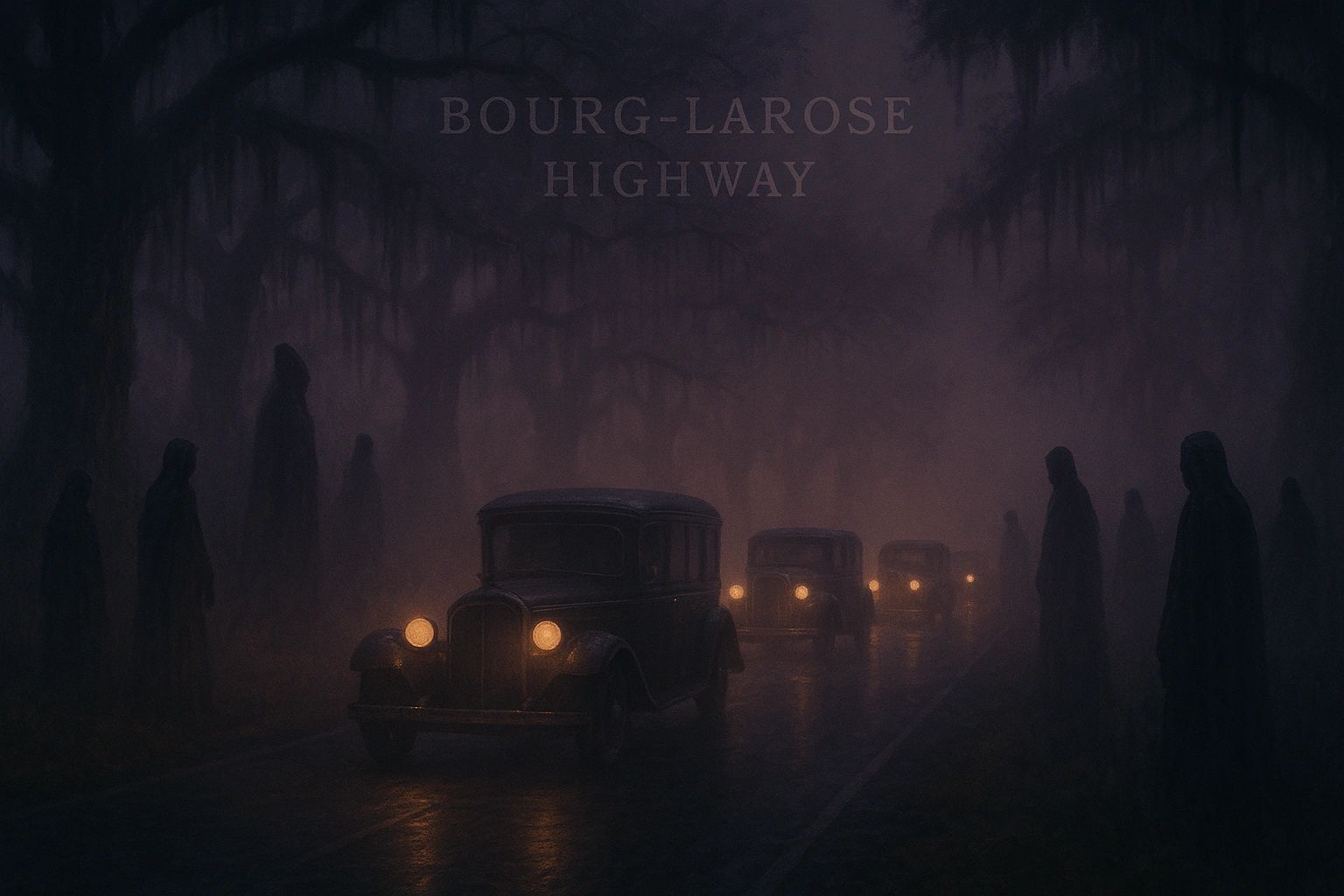
The Bourg-Larose Highway in Lafourche Parish, Louisiana, is not just a stretch of road. To the casual driver, it is a ribbon of asphalt winding through the swamps and bayous, flanked by moss-draped oaks and the dark shimmer of brackish waters. But to locals, and to those who know its history, this highway carries a reputation heavy with shadows. For generations, strange tales have circulated of ghostly funeral processions—lines of spectral cars, shadowy mourners, and phantom hearses—that emerge in the mist of night. These spectral funerals glide silently along the highway, their destination unknown, their purpose unresolved.
In the deep stillness of the Louisiana night, with the cicadas humming and the bullfrogs croaking in the ditches, the Bourg-Larose Highway becomes more than a road—it becomes a stage for the dead. The funeral processions are not ordinary hauntings. They are rituals reenacted by unseen hands, echoes of grief and sorrow carried endlessly through the night air. To drive that road at the wrong hour is to risk becoming part of their solemn march, to see death itself made visible.
This blog will delve into the legends of these funeral processions, tracing their origins, their chilling encounters, and the cultural forces that might explain why this haunting takes the form of a funeral rite.
A Highway Steeped in History and Death
The Bourg-Larose Highway cuts through some of the oldest settled regions of Lafourche Parish, an area shaped by Acadian exiles, French settlers, enslaved Africans, and Native tribes who once lived along the bayous. With each wave of people came hardship and loss. Yellow fever epidemics ravaged the communities in the 19th century. Hurricanes drowned entire generations in the low-lying lands. Work accidents in oilfields, sugar plantations, and shrimping boats added to the toll.
The funeral was a constant presence in life here, and in a small, tightly-knit Catholic region like Lafourche Parish, funerals were more than private grief—they were community rituals. The funeral procession, with its line of cars following a hearse along narrow roads, was as much a sign of respect as a passage of the soul. The highways themselves became arteries of mourning, carrying generations of the dead to their final rest.
Locals whisper that some of these processions never ended. That perhaps, somewhere between the cemeteries and the bayous, grief rooted itself into the asphalt. And that is why the Bourg-Larose Highway sometimes trembles with ghostly headlights and the slow, solemn march of funerals that never reach their graveyards.
The First Reports of Ghostly Funerals
The first documented accounts of the phantom funeral processions began in the mid-20th century, when the highway was modernized to handle increasing oil industry traffic. Workers reported late-night encounters that rattled them to the core. Truck drivers would claim to see lines of dim lights in their rearview mirrors—too dim for real headlights—stretching behind them. Sometimes they would pull over to let the procession pass, but no cars ever came.
Others described cresting a hill or rounding a bend, only to see a hearse ahead of them, an old-fashioned model gleaming silver under the moonlight. Behind it stretched a string of cars, black and silent, each with shadowy passengers. The procession would glide along steadily, until it faded into the mist or simply blinked out of existence.
A folklorist visiting the region in the 1970s collected several accounts from older residents, many of whom insisted the processions were omens. “If you see the funeral,” one elderly woman reportedly said, “it means death is coming close to you or your family.” Another man told her that his brother had seen the funeral cars three nights before their cousin drowned in the bayou.
Over time, these stories hardened into local legend: if you see the phantom procession, you must not follow it, for it will lead you astray into the swamp—or worse, into your own death.
Encounters on the Highway
The chilling encounters continue to this day, often shared in hushed tones at family gatherings or late-night campfires along the bayou.
One woman recounted driving home from a shift at a hospital in Houma when she saw a string of lights in her rearview mirror. The cars kept pace with her for miles, though she could never quite make out their shapes. Finally, she pulled into a gas station and waited. The highway behind her was empty. Yet she swears she heard faint church bells ringing as she got out of her car.
A fisherman told of seeing a funeral in the fog one dawn, the line of cars moving toward him before dissolving into the mist. Days later, a man from his town died in an accident at sea. He has never forgotten the way the hearse’s headlights looked—yellow, soft, like lanterns from another century.
Some reports are even more terrifying. A teenage boy once claimed he picked up what he thought was a hitchhiker dressed in mourning clothes, only for the figure to vanish from his backseat as he neared the bridge over Bayou Lafourche. Others speak of standing by the roadside at night, only to hear the rumble of engines and the squeak of tires on gravel, though the highway is deserted.
The funeral procession is not always seen—it is sometimes heard, sometimes felt. The line between presence and absence is blurred, as if the dead are constantly rehearsing their own passing.
The Symbolism of Funeral Processions
Why funeral processions? Why not restless spirits, or phantom brides, or headless horsemen? The answer may lie in the way death is ritualized in Cajun and Creole Louisiana. Funerals were not brief, private affairs—they were days-long rituals involving family, neighbors, and community. The procession was a sacred act, a public acknowledgment of loss and continuity.
The phantom funeral processions of Bourg-Larose Highway reflect this deep cultural connection between roadways and mourning. Roads were not simply passages for commerce; they were passages for souls. To travel behind a hearse was to take part in a collective journey into grief and remembrance.
When spectral cars return again and again to the same stretch of road, they may be echoes of countless processions held there, layered upon one another until time itself bends. Each phantom car is a memory, each shadowy figure a mourner who never reached their rest.
Possible Explanations
Skeptics have proposed natural explanations for these apparitions.
- Swamp gases and fog: The marshlands produce eerie lights, known as will-o’-the-wisps, which could be mistaken for headlights in the right conditions.
- Optical illusions: Heat haze, mist, and the flat stretches of highway can distort distant car lights, making them appear ghostly or multiplied.
- Psychological expectation: In a community steeped in legends, a driver alone on a dark road may interpret ordinary shadows or reflections as something supernatural.
Yet for those who have seen the phantom processions, no rational explanation suffices. The weight of silence, the heavy air of grief, the uncanny detail of the cars and mourners—these cannot be dismissed as tricks of the eye.
Cultural Echoes in Louisiana
Louisiana folklore is rich with tales of phantom funerals. Stories from New Orleans speak of second-line parades for the dead that never end, spectral brass bands playing faint music in the French Quarter. On rural roads across Cajun country, people whisper of death carriages and black wagons drawn by spectral horses.
The Bourg-Larose Highway processions are part of this broader tradition, rooted in the belief that the dead do not always rest easily, especially when tragedy or sudden loss is involved. The funeral is a liminal space, where the living and the dead meet. When that space lingers too long, when grief is too deep, perhaps the funeral continues forever.
Driving the Highway at Night
Travelers who drive the Bourg-Larose Highway at night often describe a sense of unease, even if they never see the funerals. The air feels heavier, the silence deeper. Locals will sometimes tell outsiders not to drive it alone after midnight, especially in foggy weather.
For those who do, there are warnings:
- Do not honk your horn at the procession, for it is seen as disrespectful.
- Do not attempt to pass the hearse, for it will lead you off the road.
- And never, under any circumstances, follow the cars into the swamp.
These rules are not just superstitions—they are survival guides. The road is dangerous at night, with narrow shoulders and deep ditches. But the warnings also carry spiritual weight. To disrespect the funeral is to disrespect the dead. And in Louisiana, the dead demand reverence.
What the Funeral Processions Mean Today
In a modern world where ghost stories are often dismissed, the Bourg-Larose Highway funeral processions endure. They speak to a community’s ongoing relationship with death, with memory, and with place. Each sighting is a reminder that grief does not vanish with time—it lingers, looping endlessly, like cars circling a cemetery.
The processions are also a form of collective storytelling. Each new account becomes part of a living folklore, one that binds Lafourche Parish residents to their history and their dead. To speak of the funerals is to honor those who came before, and to acknowledge the mystery that still hangs over the swamp.
Conclusion: A Road of Eternal Mourning
The Bourg-Larose Highway is not just haunted—it is mourned. Every phantom hearse, every shadowed mourner, every flicker of headlights in the mist speaks to the way the dead are carried with us. These funeral processions are more than ghosts; they are memories made flesh, sorrow made visible.
To drive the Bourg-Larose Highway at night is to risk brushing against eternity, to see the road not as pavement but as a passageway between worlds. And if you are unlucky—or perhaps lucky enough—you may find yourself slowing behind a line of silent cars, headlights dim, moving steadily toward the unknown.
And if you do, remember: do not follow too closely. For some roads lead only to the grave.
Bibliography
- Ancelet, Barry Jean. Cajun and Creole Folktales: The French Oral Tradition of South Louisiana. Jackson: University Press of Mississippi, 1994.
- Brandon, David, and Alan Brooke. Haunted Louisiana: Ghosts and Strange Phenomena of the Pelican State. Stackpole Books, 2008.
- Davis, John. Louisiana Ghost Stories and Legends. Pelican Publishing, 2012.
- Smith, Gregory L. Ghosts Along the Bayou: Haunted Roads and Spirits of the Deep South. Baton Rouge: Bayou Press, 2005.
- Folklore interviews collected by the Louisiana Folklife Program, Department of Culture, Recreation, and Tourism.
- Local oral traditions and family histories recorded in Lafourche Parish historical societies.
About the Author
Rebecca “Madam Chronicler” Ryan is a writer and researcher for The Chronicler Library. She is the co-creator of The Chronicle of Fear and The Waterline Chronicles, and a lead researcher and contributor for The Captain’s War Chronicles and The Captain’s Cellar. Her work blends myth, history, and the natural world with empathy, insight, and intellectual rigor.
Originally published at the live site .