
Folklore ·
The Haunting of Bayou Sale: Louisiana’s Most Terrifying Road
Introduction: The Road Where Shadows Linger
By Rebecca "Madam Chronicler" Ryan
Introduction: The Road Where Shadows Linger
Louisiana’s bayous are some of the most mysterious landscapes in America — places where fog rolls thick, cypress roots twist like skeletal fingers, and the veil between the living and the dead feels perilously thin. Among these waterways, Bayou Sale Road, also known as Highway 57, has earned a sinister reputation. Stretching between the quiet communities of Dulac and Cocodrie in Terrebonne Parish, this rural highway is whispered to be the most haunted road in Louisiana.
Those who have driven it after dark describe a suffocating silence interrupted by strange lights hovering over the swamp, phantom hitchhikers that vanish when approached, and a sense of being watched from the trees. Some claim their vehicles stall inexplicably, others swear they’ve seen the spectral woman in white who is said to wander the roadside, forever lost in the mist.
What gives Bayou Sale Road its haunted character? The answer lies in a blend of tragedy, isolation, folklore, and the eerie power of the Louisiana wetlands themselves.
1. The Setting: Where the Bayou Meets the Beyond
To understand the haunting, one must first appreciate the landscape. Bayou Sale (pronounced “BY-you Sahl”) translates roughly to “Salty Bayou,” a nod to the brackish waters that wind toward the Gulf. The road itself cuts through a labyrinth of marshlands, slow-moving waterways, and ancient cypress forests draped in Spanish moss.
At night, fog seeps across the pavement, swallowing headlights whole. The air grows heavy and wet, carrying the croak of frogs and the splash of unseen creatures. In such a setting, it isn’t difficult to imagine spirits lingering — after all, the swamp already feels half alive.
The isolation also contributes to the fear. The 20-mile stretch between Dulac and Cocodrie has long, empty sections with no gas stations, no streetlights, and barely any cell signal. Accidents are frequent. Some say the road itself feeds on tragedy — every life lost adding another ghost to its length.
2. The Legends That Haunt the Road
Over the years, countless stories have seeped into the folklore of Bayou Sale Road. Some are rooted in older Cajun legends; others appear to be modern hauntings. But nearly all share one trait — they warn travelers not to drive this road alone after dark.
The Woman in White
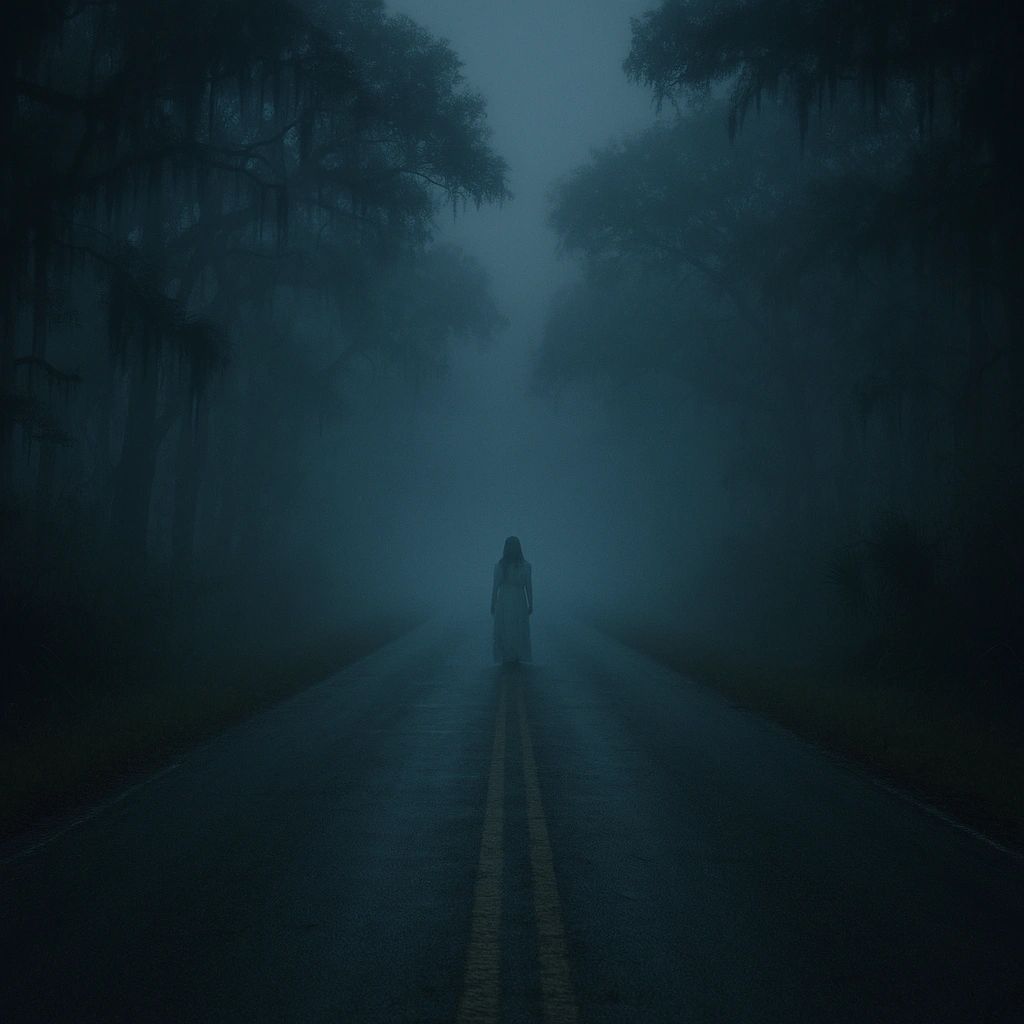
The most famous ghost said to haunt Bayou Sale Road is the Woman in White, a pale figure in a long dress seen walking or standing by the roadside at night.
Eyewitnesses claim she appears suddenly, illuminated by headlights. Some say she tries to flag down drivers; others report that she steps directly in front of cars before vanishing. A few stories go further — insisting that when the driver stops, the woman appears inside the car itself, silent, cold, and staring.
Locals tell different versions of her origin:
- One legend says she was a bride killed on her wedding day when her carriage overturned into the swamp.
- Another claims she was a young mother searching for a child lost to the waters.
- Some whisper she was the victim of a murder or hit-and-run decades ago, doomed to walk the road forever.
Though the details shift, her purpose is constant: to remind travelers that death still walks this road.
The Vanishing Hitchhiker
Another recurring tale describes a male hitchhiker dressed in old-fashioned clothing. Drivers who stop for him report that he enters the car, silent at first, before giving directions that lead nowhere. Then, without warning, he disappears — leaving only the faint smell of swamp water or pipe tobacco behind.
The “vanishing hitchhiker” is a classic American ghost motif, but Bayou Sale’s version is uniquely Cajun. Some say he’s the spirit of a fisherman lost in the marsh during a hurricane. Others think he’s a spirit guide or trickster, leading people astray for his own amusement.
The Phantom Lights
Dozens of travelers describe seeing mysterious orbs or “will-o’-the-wisps” floating above the water beside the road. These lights glow white, blue, or orange and seem to move with intelligence — darting away when approached, sometimes following vehicles for miles.
Skeptics point to swamp gas (methane) as the likely culprit. But locals insist the lights appear too purposeful — as if they are eyes watching from the darkness, or souls still seeking the shore.
Strange Sounds and Lost Time
Some claim that on certain nights, Bayou Sale Road becomes unnaturally silent. The usual chorus of frogs and insects cuts off, and in the silence, travelers hear faint whispers or the sound of footsteps pacing alongside their vehicles.
Even stranger are the reports of lost time — drivers who swear they traveled the short stretch in minutes one night, only to take hours the next with no memory of what happened in between.
In Cajun lore, this kind of disorientation often signals the work of spirits, leading mortals off their path or into another realm entirely.
3. The History Beneath the Haunting
Folklorists say every haunting begins with history. Bayou Sale’s reputation may be rooted in a series of tragic events dating back more than a century.
During the late 1800s and early 1900s, the area around Bayou Sale saw the rise of logging and trapping communities. Many workers lived in isolation, traveling by boat or wagon. Fatal accidents in the swamp were common — drownings, equipment failures, even alligator attacks. Bodies were often never recovered, swallowed by the bayou’s depths.
Later, in the mid-20th century, Highway 57 was paved, cutting directly through this treacherous terrain. Its long, dark stretches soon became the site of numerous fatal car crashes, especially before guardrails and reflective signage were added.
According to local newspaper archives and oral histories, the combination of fog, wildlife, and alcohol often led to disaster. Over time, each tragedy added another ghost to local storytelling — perhaps explaining why so many spirits now “walk” the road.
4. Cajun and Creole Supernatural Beliefs
Louisiana’s folklore is unlike anywhere else in the United States. French, African, Spanish, and Native American traditions have blended over centuries to produce a tapestry of voodoo, gris-gris, and ghostly belief.
Two concepts are especially relevant to Bayou Sale’s legend:
The Rougarou
The Rougarou is Louisiana’s version of the werewolf — a shape-shifting creature said to haunt the bayou and punish those who break Lenten rules. Though usually associated with the swamps near Houma and Lafourche, some locals claim it prowls Bayou Sale Road as well, glowing eyes seen between the trees.
Spirits of the Water
Many Cajun and Native American tales describe the bayou as a threshold — a place where spirits linger between worlds. Water, in these stories, acts as a mirror to the spirit realm. To this day, fishermen often refuse to speak certain names or whistle at night, fearing it will call the dead from the water.
In this context, Bayou Sale Road isn’t just haunted by accident victims; it’s a supernatural crossing point, a place where spirits naturally drift between this world and the next.
5. Eyewitness Accounts and Modern Encounters
The Internet has breathed new life into Bayou Sale’s haunting. Websites like HauntedPlaces.org and Hauntpedia host dozens of first-hand accounts:
“My sister saw a hitchhiker on the side of the road around midnight. When she slowed down, the person vanished.” — User submission, HauntedPlaces.org (2018)
“My truck lights flickered, the engine died, and I saw a woman standing in the road. She was gone when I stepped out.” — Anonymous, Hauntpedia (2019)
“I hit something one night on Bayou Sale Road — but when I looked, there was nothing there. No animal, no dent. Just a cold chill.” — User comment, HauntedPlaces.org (2020)
Many of these stories share common details: headlights flickering, vehicles stalling, or the sudden appearance of a figure in white. Even skeptics admit the sheer number of consistent accounts is uncanny.
6. Rational Explanations (and Why They Don’t Stop the Fear)
For every ghostly tale, there’s a possible rational explanation:
- Swamp Gas: Methane released from decaying vegetation can ignite, producing glowing orbs — a scientific explanation for the “will-o’-the-wisps.”
- Optical Illusions: Fog, headlights reflecting on water, or moisture on the windshield can create the illusion of movement or figures.
- Electrical Humidity Issues: The swamp’s humidity can interfere with vehicle wiring, causing headlights or engines to malfunction.
- Psychological Priming: Knowing the road’s reputation can heighten suggestibility. Once you expect ghosts, every sound and shadow feels supernatural.
Yet, these explanations do little to quiet the chill that creeps up your spine when you’re actually there. Rationality fades when the mist thickens and something pale flickers in your headlights.
The road’s isolation and danger make it an easy stage for fear — and fear itself is the perfect haunting.
7. Symbolism and the Power of Place
Why do haunted roads like Bayou Sale capture our imagination so deeply? The answer lies in the symbolism of the road itself. Roads are liminal — neither destination nor home, but the space in between. They represent transition, change, and vulnerability.
Combine that with Louisiana’s swampy environment — a place already associated with decay, death, and rebirth — and you get a landscape that feels spiritually charged. The haunting becomes a mirror of human anxiety about the unknown, isolation, and mortality.
Bayou Sale Road, then, is more than a haunted highway; it’s a psychological frontier, where the natural and supernatural blur.
8. What It’s Like to Visit
Many thrill-seekers and paranormal enthusiasts travel Bayou Sale Road hoping to experience something otherworldly. Some go alone, others in groups armed with cameras, EMF detectors, and recorders.
Here’s what they report:
- The silence is overwhelming once you turn off your engine.
- Fog banks rise suddenly, swallowing everything.
- Wildlife noises echo strangely — a frog’s croak sounding like a human sigh.
- Headlights sometimes seem to dim or reflect from nowhere.
- Even seasoned ghost hunters admit to an uneasy feeling that “something is there.”
For those who visit, two rules apply:
- Drive safely — the road’s physical dangers are more real than any ghost.
- Respect the locals and the environment — Bayou Sale is a living ecosystem, not a movie set.
9. The Haunting as a Reflection of Culture
In many ways, the legend of Bayou Sale Road mirrors the essence of Louisiana itself — a place where beauty and danger intertwine, where faith and folklore coexist, and where the past is never truly gone.
Every parish, every bayou has its stories, but Bayou Sale’s legend stands out because it feels plausible. The swamp could hide ghosts. Its waters could hold memories. And the quiet hum of cicadas might well be whispers from those who came before.
For Cajuns, stories like these serve not just to frighten, but to connect generations — preserving oral traditions that might otherwise fade. When a grandparent warns you not to drive Bayou Sale at midnight, it’s not just superstition; it’s a cultural inheritance.
10. A Drive into the Dark: The Experience in Words
Imagine this:
You’re driving south from Houma just after sunset. The last pink light fades behind the treeline, and soon the world is gray. The road narrows. Cypress knees rise like blackened teeth from the swamp.
The hum of your tires becomes the only sound. Then — the headlights flicker.
Something pale stands ahead, half-visible through the fog. A woman? You ease off the gas. For a moment she’s there, her dress fluttering, her eyes two dark pools. Then — nothing. The road is empty.
You exhale, heart pounding, unsure if you saw a ghost or the play of light on mist. You keep driving, unwilling to stop, certain that if you look in the rearview mirror you might see her there — in the back seat, waiting.
That’s Bayou Sale Road. Haunted or not, it lingers with you long after you’ve left it behind.
Conclusion: The Road That Remembers
Every state has its haunted places, but few carry the weight of Bayou Sale Road. Whether the stories are real, imagined, or somewhere in between, they speak to something universal — our fascination with death, mystery, and the unseen world around us.
In the end, perhaps Bayou Sale is haunted not by spirits, but by memory itself — the echoes of those who once passed through the swamp and never came back. The mist rising from the bayou might simply be fog, but it could also be the breath of the past whispering, I’m still here.
Drive carefully. Keep your eyes on the road — and whatever you do, if you see a woman in white by the cypress trees… don’t stop.
Bibliography
- “Bayou Sale Road.” HauntedPlaces.org. Accessed October 2025. https://www.hauntedplaces.org/item/bayou-sale-road
- “Riding Louisiana’s Most Haunted Road: Highway 57.” Law Tigers Motorcycle Blog, 2023. https://lawtigers.com/riding-highway-57-louisianas-most-haunted-road
- “Haunted Roads in Louisiana.” 107.9 ISHOT Radio, 2022. https://1079ishot.com/haunted-road-louisiana
- “Creepy Louisiana Swamp Legends.” Ranker Paranormal Section, 2023. https://www.ranker.com/list/creepy-louisiana-swamp-legends/erin-mccann
- “Haunted Places: Bayou Sale Road, Terrebonne Parish.” Hauntpedia, 2021. https://hauntpedia.com/haunted-places/state/louisiana/bayou-sale-road
- Gardevoirci, Nicholls State University. “Haunted Locations on the Bayou.” Student Publication, 2019. https://gardevoirci.nicholls.edu/2019/haunted-locations-on-the-bayou
- “8 Haunted Roads in Louisiana.” 107 JAMZ Radio, 2023. https://107jamz.com/8-roads-louisiana-haunted
- Oxford Stories. “Strange Haunted Roads in Louisiana Where Gravity Doesn’t Exist.” 2020. https://oxfordstories.net/two-strange-haunted-roads-in-louisiana-where-gravity-doesnt-exist
- Mohave TV. “A Haunted Road in Louisiana.” 2024. https://mohavetv.com/a-haunted-road-in-louisiana
About the Author
Rebecca “Madam Chronicler” Ryan is a writer and researcher for The Chronicler Library. She is the co-creator of The Chronicle of Fear and The Waterline Chronicles, and a lead researcher and contributor for The Captain’s War Chronicles and The Captain’s Cellar. Her work blends myth, history, and the natural world with empathy, insight, and intellectual rigor.
Originally published at the live site .