
Folklore ·
The Haunting of Bayou St. John
Where history whispers through cypress trees and restless spirits drift along the dark waters of New Orleans’ oldest bayou.
By Rebecca "Madam Chronicler" Ryan
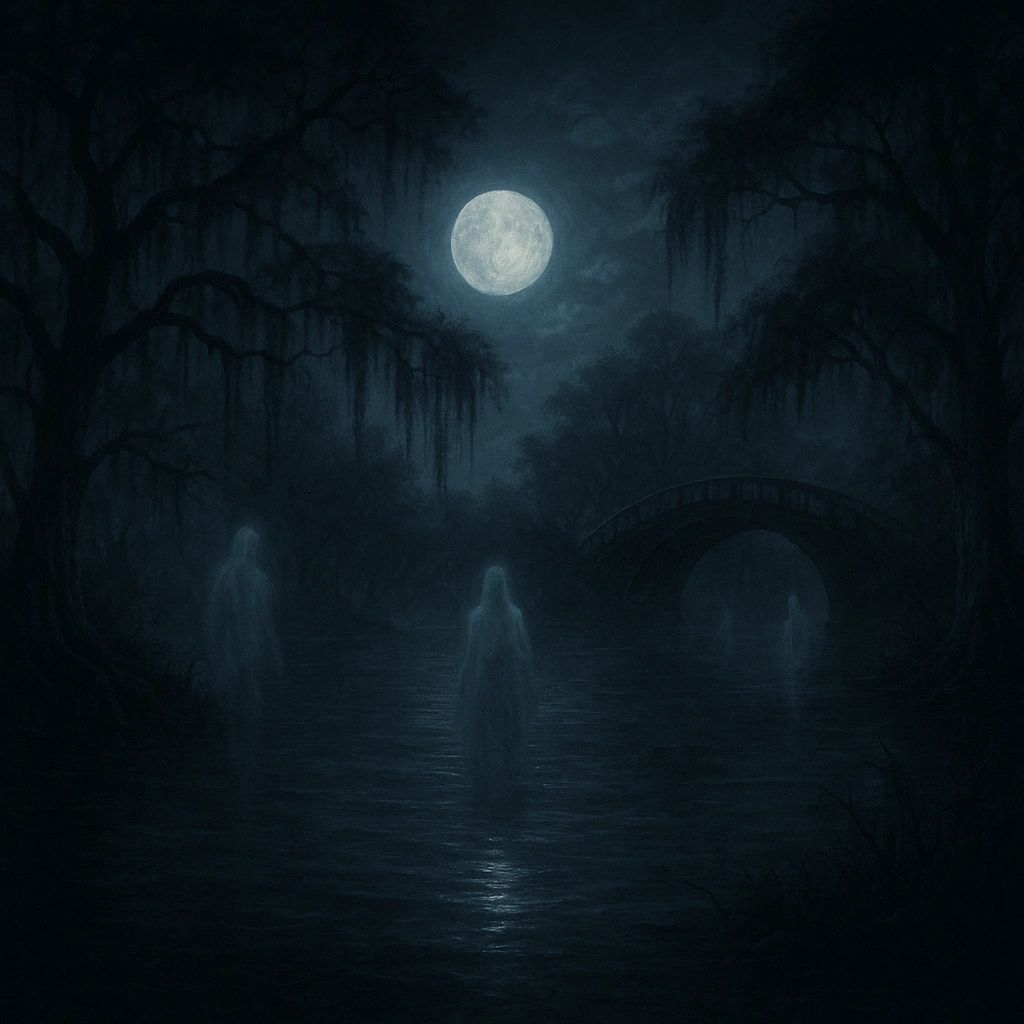
Where history whispers through cypress trees and restless spirits drift along the dark waters of New Orleans’ oldest bayou.
Beneath the Still Water
Bayou St. John is one of New Orleans’ most enduring and mysterious waterways — a slow-moving stretch of dark water running through Mid-City, lined with moss-draped oaks, 18th-century homes, and echoes of centuries past. On the surface, it’s a tranquil escape from the chaos of Bourbon Street. But as locals will tell you, these waters are not silent.
Here, beneath the reflection of the moon, ghosts of the city’s earliest days are said to stir. From Indigenous spirits to Voodoo priestesses, drowned lovers, and long-forgotten soldiers, Bayou St. John is a place where history refuses to rest.
Introduction 1. A Place Older Than New Orleans Itself
Before New Orleans was even a dream, the land that would cradle Bayou St. John was alive with activity. Indigenous peoples, including the Bayogoula and Choctaw tribes, used the waterway as a vital trade route between Lake Pontchartrain and the Mississippi River. Archaeological finds show that this area was inhabited long before Europeans set foot in Louisiana.
The bayou provided food, transportation, and spiritual sustenance. Its still waters reflected the natural rhythms of life — and perhaps, death. Many Native American legends speak of water spirits who guarded the boundaries between the living and the dead. Some say these early stories laid the foundation for the hauntings that still cling to the bayou’s banks today.
When French explorers arrived in 1699, Indigenous guides showed them this very passage. It became so vital to commerce that it directly influenced the decision to build New Orleans nearby in 1718. From the beginning, Bayou St. John was a portal — both literal and spiritual — linking the old and the new, the living and the departed.
2. The Colonial Years: Canal, Commerce, and the Cost of Labor
As the French and later the Spanish settled the area, Bayou St. John grew into a busy commercial artery. Barges and schooners traveled its length, carrying goods between the city and the lake. In 1794, the Carondelet Canal was completed, connecting the bayou directly to the French Quarter and transforming it into a lifeline of trade.
But prosperity came at a price. Enslaved Africans and Native laborers dug the canal by hand under brutal conditions. Countless workers died from disease, exhaustion, or mistreatment. Locals say their cries still echo through the cypress trees at night — ghostly laments for lives stolen and forgotten.
Residents claim that near the old canal locks, you can sometimes hear the sound of wooden shovels scraping or see ripples spreading across still water when there is no wind. Some believe these are the restless spirits of those who built the waterway and were never given peace.
3. The Bayou and the Voodoo Queen
No story of Bayou St. John is complete without Marie Laveau, the legendary Voodoo Queen of New Orleans. During the 19th century, Laveau was said to hold her most famous rituals on the banks of this bayou — especially on St. John’s Eve, the night of June 23rd.
Thousands of followers, free people of color, enslaved individuals, and curious onlookers would gather beneath the moonlight near what’s now the Magnolia Bridge. Drumming, dancing, chanting, and offerings filled the humid air as fires flickered on the water.
Even today, locals say that if you walk near the bridge on St. John’s Eve, you may hear the faint rhythm of drums or smell the waft of incense drifting through the darkness. Some claim to see ghostly figures moving between the trees — echoes of the Voodoo ceremonies that once summoned spirits from the other side.
Modern practitioners of Louisiana Voodoo still gather at Bayou St. John every June 23rd to honor Laveau and the ancient spiritual traditions she preserved. Though these ceremonies are peaceful and joyous, some participants say the veil between worlds feels thinner there than anywhere else in New Orleans.
4. The Spanish Fort and the Soldier Spirits
At the mouth of the bayou, near Lake Pontchartrain, stand the crumbling remnants of Spanish Fort — a site that has seen centuries of conflict, celebration, and tragedy.
Originally built by the French in the 1700s and later fortified by the Spanish, the fort was used to defend New Orleans from invasion. During the War of 1812 and the Civil War, soldiers camped and fought here, some never to return home.
After the wars, the fort became an amusement park in the late 19th century — complete with music halls, casinos, and roller coasters. Locals joked that the dead soldiers never left and watched the revelry with disapproval. Patrons and workers reported strange occurrences: cold spots, spectral figures in uniform, and the sound of boots pacing on the ramparts.
Even now, visitors to Spanish Fort say they feel an uneasy presence. Ghost hunters report EMF spikes, sudden temperature drops, and voices captured on EVP recorders whispering in Spanish or French. Whether these are echoes of old soldiers or the memories of centuries past, Spanish Fort remains one of the bayou’s most haunted corners.
5. The Drowned Lovers and the Woman in White
Another persistent tale speaks of the Woman in White, a ghost said to wander the banks of Bayou St. John searching for her lost love.
According to one version, she was the daughter of a wealthy Creole family forbidden to marry a young man of lower status. Desperate, they planned to elope by boat across the bayou one stormy night. But the small vessel capsized, and her lover drowned before her eyes. Heartbroken, she waded into the dark water to join him.
Residents say that on humid summer nights, when fog drifts low over the bayou, a pale figure can be seen gliding across the surface — her face mournful, her dress trailing in the current. Those who see her claim she disappears if approached, leaving only ripples on the water.
Skeptics dismiss it as moonlight reflecting off mist, but locals know better. The Woman in White has been seen for generations — her legend entwined with the bayou itself.
6. Phantom Drums and the Bayou’s Restless Energy
Even outside of Voodoo celebrations, Bayou St. John has a distinct spiritual energy. Paranormal investigators report strange sounds, particularly rhythmic drumming, when no ceremonies are taking place.
Some attribute these noises to residual energy — echoes of centuries of ritual and emotion imprinted on the land. Others believe they’re signs of active spirits. Witnesses describe feeling watched, seeing shapes move through the trees, or hearing footsteps following them along the path even when they’re alone.
Perhaps the bayou’s still waters act as a mirror between worlds — reflecting not only the living but the dead as well.
7. The Magnolia Bridge: Portal of the Past
The Magnolia Bridge, a graceful white footbridge spanning the bayou, is one of the most iconic and haunted sites in the city. Built in the 1800s, it has witnessed countless processions, festivals, and ceremonies.
Locals call it “the bridge between worlds.” On moonlit nights, people have reported seeing shimmering figures crossing it — translucent and silent. Some say these are spirits drawn to the bridge during St. John’s Eve, returning to participate in the rituals that once brought life and death together in celebration.
Others tell of a darker presence — a shadowy figure that stands motionless on the bridge late at night before vanishing into the mist. Kayakers have sworn they saw someone standing there in old-fashioned clothes, only to realize no one else was around when they reached the bank.
8. The Bayou as a Living Memory
Hauntings are often born from places steeped in memory, and Bayou St. John has witnessed more than three centuries of joy, tragedy, and transformation. From the first Indigenous settlements to colonial exploitation, from Voodoo rites to modern-day festivals, the bayou has absorbed every emotion its visitors have ever left behind.
Some anthropologists describe such places as “memoryscapes” — landscapes that hold the residue of human experience. The bayou’s haunting, then, isn’t just a collection of ghost stories. It’s the living history of New Orleans itself, flowing through water and time.
Standing on its banks, you can feel it: the hush before a drumbeat, the flicker of light on dark water, the hum of something ancient just below the surface.
9. Experiencing the Haunting for Yourself
If you want to explore Bayou St. John’s spectral side, locals recommend approaching with respect — and an open mind.
Where to Go:
- Magnolia Bridge: Best visited at twilight. This is the heart of many haunting legends and ritual events.
- Spanish Fort Ruins: Near the mouth of the bayou by Lake Pontchartrain. A hotspot for paranormal activity.
- Carondelet Canal Remains: Walk along Moss Street to sense the deep history beneath the surface.
What to Watch For:
- Sudden chills, even on hot nights.
- Faint drumming or chanting.
- Ripples or footsteps with no visible source.
- Glimpses of movement across the bridge or water.
Bring a camera, but don’t expect proof. The bayou’s ghosts reveal themselves not to lenses, but to intuition — in the flicker of a feeling, in the sudden awareness that you are not alone.
10. The Meaning Behind the Haunting
The Haunting of Bayou St. John isn’t merely about restless spirits. It’s about the echoes of history — the city’s triumphs, injustices, and resilience, all imprinted in a single landscape.
To the enslaved, it was a corridor of survival and sorrow. To Indigenous tribes, a sacred pathway. To Voodoo practitioners, a sacred site of communion. To modern residents, it’s a reminder that New Orleans’ soul lives in its stories — stories that refuse to die.
In this sense, Bayou St. John’s haunting is a form of remembrance. Each ripple, each whisper through the cypress branches, keeps alive the memory of those who came before.
Conclusion: The Water Remembers
Walk along Bayou St. John at night and you’ll understand why so many call it one of the most haunted places in Louisiana. It’s not just the darkness or the fog — it’s the feeling that time itself has thinned. The bayou moves slowly, like a heartbeat, pulsing with the memory of centuries.
Perhaps that’s why people still see figures by the water, hear phantom drums, or catch the scent of incense on the breeze. The spirits of Bayou St. John are not malevolent — they are guardians of a place where the past still breathes.
In the end, the haunting of Bayou St. John reminds us of a truth older than New Orleans itself: water holds memory, and memory never dies.
Bibliography
- “Bayou St. John.” Wikipedia, Wikimedia Foundation. https://en.wikipedia.org/wiki/Bayou_St._John
- “History of Bayou St. John.” Friends of Bayou St. John. https://www.bayoustjohn.org/history-of-bayou-st-john
- “The Haunted Bayou: Exploring Southern Ghostlore and Legends.” Mythology Worldwide. https://mythologyworldwide.com/the-haunted-bayou-exploring-southern-ghostlore-and-legends
- “Haunted Bayous of Louisiana.” Haunted New Orleans Tours. https://www.hauntedneworleanstours.com/hauntedbayous
- “Ghost Stories and Cultural Heritage in the Bayou.” Connect Paranormal, 2025. https://connectparanormal.net/2025/10/21/ghost-stories-and-cultural-heritage-in-the-bayou
- Long, Carolyn Morrow. A New Orleans Voudou Priestess: The Legend and Reality of Marie Laveau. University Press of Florida, 2006.
- Sublette, Ned. The World That Made New Orleans: From Spanish Silver to Congo Square. Lawrence Hill Books, 2008.
- Reis, Elizabeth. Bodies in Doubt: An American History of Intersex. Johns Hopkins University Press, 2009 (for context on ritual spaces and body spirituality in 19th-century New Orleans).
- Pitre, Glen. Louisiana Spirits: Ghosts and Legends of the Bayou State. Pelican Publishing, 1996.
- DeLavigne, Paul. “The Spirits of Bayou St. John.” Louisiana Folklore Journal, vol. 42, no. 3, 2019.
About the Author
Rebecca “Madam Chronicler” Ryan is a writer and researcher for The Chronicler Library. She is the co-creator of The Chronicle of Fear and The Waterline Chronicles, and a lead researcher and contributor for The Captain’s War Chronicles and The Captain’s Cellar. Her work blends myth, history, and the natural world with empathy, insight, and intellectual rigor.
Originally published at the live site .