
The Haunting of Lafitte’s Blacksmith Shop and Bar
In the heart of New Orleans, where wrought-iron balconies hang like lace and the air hums with jazz, there stands a dimly lit building whose walls have witnessed centuries of intrigue, sin, and whispers of the supernatur...
By Rebecca "Madam Chronicler" Ryan
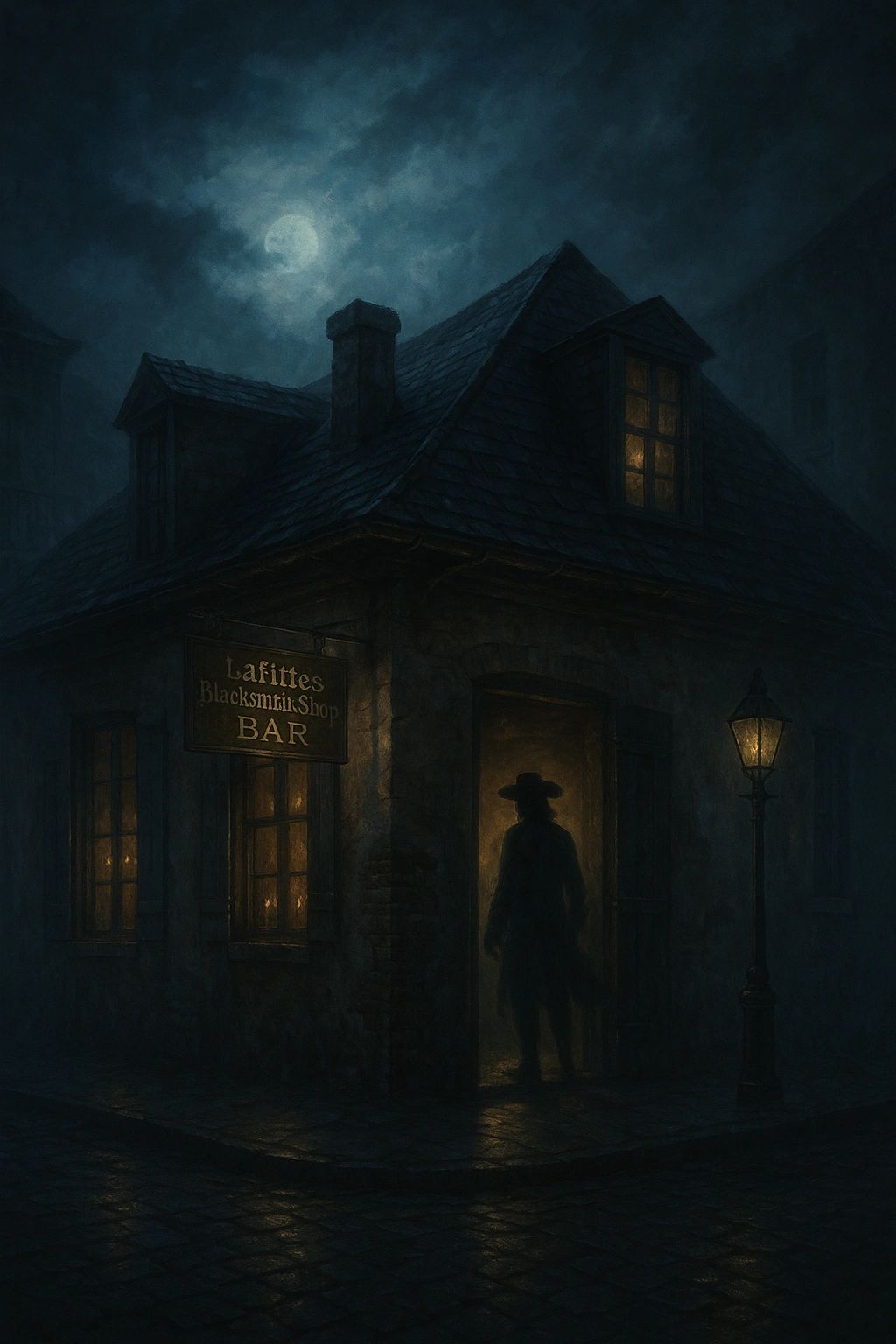
In the heart of New Orleans, where wrought-iron balconies hang like lace and the air hums with jazz, there stands a dimly lit building whose walls have witnessed centuries of intrigue, sin, and whispers of the supernatural. On the corner of Bourbon and St. Philip Streets, Lafitte’s Blacksmith Shop and Bar sits cloaked in shadows — a dark stone structure whose flickering candles seem to keep time with the restless spirits that linger within.
To most, it’s a favorite watering hole. To others, it’s one of the most haunted places in the French Quarter — a place where history refuses to rest, and where one man’s legend has burned as fiercely as the rum that flows behind the bar.
That man was Jean Lafitte, the infamous pirate, privateer, and smuggler whose name still echoes through New Orleans’ cobblestone streets like a ghostly warning. And according to countless witnesses, his spirit never truly left the bar that bears his name.
A Tavern Born of Fire and Shadows
Lafitte’s Blacksmith Shop is more than a bar — it’s a survivor. Built between 1722 and 1732, it’s one of the oldest standing buildings in New Orleans, constructed in the French Colonial style with heavy bricks, sloping roofs, and a hauntingly dim interior. The building’s very bones carry the city’s early history — years of fires, storms, and revolutions that scarred but never broke the Quarter.
During the 18th century, the structure was allegedly home to Jean and Pierre Lafitte’s blacksmithing business — at least, that was the cover story. In truth, it’s said the brothers used the shop as a front for smuggling and privateering operations, fencing stolen goods and arranging deals with sailors under the cover of the night.
While official records on this arrangement are murky, oral tradition in New Orleans is crystal clear: the Lafittes used this shop to mask their darker dealings. It was where pirates met under flickering lanterns, where coded whispers passed between smugglers, and where barrels of rum and stolen treasure changed hands.
And like everything born in New Orleans’ underbelly, this place has secrets — and spirits — that refuse to die.
Jean Lafitte: The Gentleman Pirate
Jean Lafitte was not your typical pirate. He didn’t sail under a black flag or pillage random ships. Instead, he operated out of Barataria Bay, just south of New Orleans, running a complex network of privateers who captured Spanish vessels under semi-legal conditions. He was charming, educated, and ruthless — known for both his silver tongue and his pistol.
Lafitte’s legend took hold during the early 1800s when he struck a deal with General Andrew Jackson during the Battle of New Orleans in 1815. Offering his ships, men, and munitions, Lafitte helped turn the tide against the British. In exchange, he was granted a pardon for his crimes — but his myth grew much larger than any military victory.
Some say Lafitte’s treasure — the one he swore he’d reclaim even in death — was hidden somewhere in Louisiana’s bayous or perhaps within the French Quarter itself. And that’s where the haunting begins.
The Ghost of Jean Lafitte
For over a century, patrons and staff at Lafitte’s Blacksmith Shop have claimed to see Jean Lafitte’s ghost. His figure often appears near the darkened corners of the bar, his shadow flickering against the old brick as though illuminated by phantom candlelight.
Witnesses describe him as a tall man in dark clothing, often wearing a wide-brimmed hat, his expression stern yet strangely calm. He never speaks, never interacts — he only watches. Some say he leans against the fireplace, his favorite spot in life. Others claim to have seen him reflected in mirrors, only to vanish when they turn around.
One bartender recounted that on quiet nights, when the last patrons had gone and the bar was being cleaned, the smell of cigar smoke would fill the air — though no one had been smoking for hours. The smoke would linger near the fireplace before fading away, leaving behind an eerie stillness.
And then there’s the most chilling detail: those who have locked eyes with Lafitte’s ghost often report feeling a sudden drop in temperature, followed by a strange whisper — a sound like the rolling of waves, or the creak of a ship’s deck.
Many believe Jean Lafitte is still watching over his old base of operations, perhaps guarding what remains of his secret treasures. Others think his spirit is tethered there by pride — a pirate who refuses to leave his empire behind.
The Fireplace and the Flames
The fireplace at Lafitte’s is more than a cozy relic — it’s said to be a portal of sorts. Countless reports describe flickering blue flames that appear even when the fire has long gone cold. Bartenders have seen the hearth burst to life without a match or log in sight.
Some patrons have claimed to see a pair of glowing red eyes in the fire — eyes that watch them until they look away. Others describe feeling a burning sensation on their necks or arms, as if a phantom ember had touched them.
One visitor even captured a photo of the fireplace when it appeared to show a man’s face — half in shadow, half in flame. Skeptics dismissed it as coincidence, but locals whisper that it was Lafitte himself, keeping watch over his domain.
The Woman Upstairs
Lafitte’s isn’t haunted by only one ghost. A mysterious woman in 18th-century clothing is often seen upstairs, wandering near the windows that overlook Bourbon Street. Some describe her as young and beautiful, her hair pinned up in French curls. Others say she appears pale and sorrowful, as if searching for something — or someone — she’s lost.
One of the prevailing theories is that she was a lover of Jean Lafitte, left behind when he fled New Orleans. Another suggests she was a victim of his darker side — one of the many souls who crossed his path and paid a price.
Patrons who have ventured upstairs — especially late at night — claim to feel a crushing weight of sadness, or hear soft weeping near the walls. Occasionally, a cold hand brushes against their shoulder, and when they turn, there’s no one there.
The Shadows That Move on Their Own
Even those who don’t believe in ghosts often leave Lafitte’s feeling unsettled. The interior, lit mostly by candlelight, creates a timeless atmosphere — part romance, part unease. The bar’s decision to avoid electric lighting adds to its authenticity… and its eeriness.
But those flickering flames have a way of playing tricks on the eye. Shadows shift when no one moves. Figures appear to walk past the doorway, only to disappear.
Paranormal investigators have documented strange energy readings inside the bar — particularly near the back corner by the piano, where cold spots appear even in the height of summer. Some claim that disembodied voices have been recorded, whispering in both French and English, as if echoing from another time.
Laughter from the Past
Despite its darkness, Lafitte’s Blacksmith Shop isn’t only filled with fear. There are moments of inexplicable joy — bursts of laughter that come from nowhere, the faint sound of music drifting from the piano when no one is seated there.
It’s as if the building carries not just its hauntings, but also the energy of every party, every toast, every song that’s ever filled its walls. The ghosts, in their own way, seem to celebrate the life that continues around them.
Some locals say that’s the true magic of New Orleans — its ability to make death feel like part of the celebration. At Lafitte’s, the veil between life and afterlife is paper-thin, and both sides seem content to share a drink from time to time.
A Bar Like No Other
Stepping inside Lafitte’s Blacksmith Shop today feels like stepping back in time. The air is thick with the scent of old wood, rum, and history. Tourists crowd the small rooms, their faces illuminated by candlelight, unaware that centuries of souls may be watching them.
The piano still plays, the laughter still echoes, and somewhere — perhaps near the fireplace — the pirate himself stands silently, guarding his secrets.
The Legend of the Hidden Treasure
Perhaps the most enduring mystery surrounding Lafitte’s Blacksmith Shop is the rumor of Lafitte’s buried treasure.
Some say that Lafitte hid his gold somewhere in the building, buried beneath the floorboards or sealed behind a wall. Others believe it lies somewhere in the bayous beyond New Orleans, where ghosts of his crew still guard it.
But there’s one story that refuses to fade: that those who search too hard for Lafitte’s treasure will be cursed. Bartenders have told tales of guests who bragged about treasure hunts, only to experience strange accidents or nightmares afterward. One local historian claimed to have found a hidden alcove beneath the shop — but when he returned the next day to investigate, it had vanished.
It’s said that Jean Lafitte himself appears to those who get too close to his gold — his dark eyes burning with warning.
Encounters Through the Years
Over the decades, countless witnesses have added to Lafitte’s legend.
- In the 1940s, a tourist claimed to see a man in a tricorn hat standing by the bar, who vanished when she tried to speak to him.
- In the 1970s, a bartender reported seeing shadowy figures moving in the backroom long after closing.
- In the 1990s, a group of paranormal researchers recorded what they believed were EVP voices saying “Mon trésor” — “My treasure.”
- And even today, visitors post photos online showing misty shapes, glowing orbs, and faces appearing in the candlelight.
The ghost of Lafitte has even been said to follow certain visitors out of the bar, especially those who mock his legend. One woman claimed that after joking about pirates, she returned to her hotel to find her necklace missing, only to have it reappear on her pillow the next morning — clasped shut.
Why the Spirits Stay
What is it that binds these spirits to Lafitte’s Blacksmith Shop?
Maybe it’s the weight of history — every brick saturated with memories of rum, rebellion, and revelry. Maybe it’s unfinished business, the lure of treasure not yet claimed. Or maybe, just maybe, it’s because Jean Lafitte never truly left New Orleans.
He was a man who loved this city, who fought for it, profited from it, and shaped it in ways that echo even now. Perhaps his ghost lingers not as a curse, but as a guardian — a pirate still watching over his port.
The French Quarter at Night
Outside, the French Quarter comes alive after dark. Street performers dance beneath gas lamps, jazz spills from open doorways, and carriages roll past like phantoms of another century. But amid the laughter and music, there’s always a sense of something else — an undercurrent of mystery, a whisper from the past.
Lafitte’s Blacksmith Shop stands at the heart of it all, a reminder that in New Orleans, the line between the living and the dead has never been clear. Here, ghosts aren’t feared — they’re part of the story.
The Eternal Toast
Those who visit Lafitte’s often raise a glass “to Jean.” It’s part tribute, part superstition. To some, it’s a way to show respect — to let the pirate know you mean no harm. To others, it’s an invitation, a way of saying, “Join us for one more drink.”
If you listen closely, some swear they’ve heard the faint clink of a ghostly glass in return.
So the next time you find yourself in the French Quarter, step through those weathered wooden doors. Order a drink, find a quiet corner, and watch the firelight dance on the walls. You might just catch a glimpse of a man in a wide-brimmed hat, watching you from the shadows — a pirate who’s made peace with eternity, one ghostly toast at a time.
Epilogue: The Soul of the Quarter
Lafitte’s Blacksmith Shop isn’t just haunted because of ghosts. It’s haunted because it remembers — every laugh, every secret, every sin. In a city where history and legend intertwine like roots beneath the cobblestones, the shop stands as a living monument to what New Orleans truly is: a place where life and death dance to the same rhythm, where every spirit — living or lost — has a story to tell.
And as long as the candles burn low and the rum keeps flowing, Jean Lafitte will always be there — waiting in the shadows, smiling that same pirate’s smile.
Bibliography
- Smith, Jonathan. Ghosts of the French Quarter: Haunted New Orleans Tales. Crescent City Press, 2016.
- Long, Laura. The Spirits of Bourbon Street. Louisiana Folklore Society, 2018.
- “Lafitte’s Blacksmith Shop Bar.” National Register of Historic Places, U.S. Department of the Interior, 1970.
- Guste, Roy F. New Orleans: Then and Now. Pelican Publishing, 2019.
- O’Malley, Erin. “The Haunting of Jean Lafitte’s Blacksmith Shop.” New Orleans Historical Journal, 2021.
- Official site of Lafitte’s Blacksmith Shop Bar – https://www.lafittesblacksmithshop.com
- New Orleans Ghost Tour Archives, HauntedHistoryTours.com, accessed 2025.
About the Author
Rebecca “Madam Chronicler” Ryan is a writer and researcher for The Chronicler Library. She is the co-creator of The Chronicle of Fear and The Waterline Chronicles, and a lead researcher and contributor for The Captain’s War Chronicles and The Captain’s Cellar. Her work blends myth, history, and the natural world with empathy, insight, and intellectual rigor.
Originally published at the live site .