
Folklore ·
The Haunting of Lake George in Volusia County, Florida
By Chronicles of Fear
By Rebecca "Madam Chronicler" Ryan
ByChronicles of Fear
Introduction
Shrouded in mist and mystery, Lake George—Florida’s second-largest lake—rests quietly along the serpentine path of the St. Johns River. On the surface, it’s a paradise for anglers, boaters, and nature enthusiasts. But beneath that still expanse of brackish water lies something far older and darker—a haunting history whispered through the cypress groves and the fog that clings to its banks.
Located partly in Volusia County, Lake George’s tranquil beauty hides tales of tragedy, restless spirits, and strange phenomena that have baffled locals for decades. From the unsolved murder of a lighthouse keeper to mysterious lights over the water, this lake’s haunted legacy is as deep as the St. Johns River itself.
This is the story of The Haunting of Lake George—where Florida’s wilderness meets the supernatural.
I. The Historical Depths of Lake George
The Lake of Many Names
Before it was called Lake George, the Timucua people knew it by another name—one that has been lost to time. They lived, hunted, and buried their dead along the river’s edge for centuries before European contact. Archaeological surveys reveal shell middens, burial mounds, and artifacts that speak of an enduring relationship between people and this place long before Florida appeared on any map.
In 1765, British botanist John Bartram named the lake after King George III, during an exploration of East Florida. To early settlers, the lake was a watery gateway into a largely uncharted wilderness. To Native Americans, it was sacred. That spiritual reverence—tied to life, death, and water—may be the first root of its haunting.
Conflict and Change
Lake George bore witness to centuries of human struggle:
- Colonial conflict: Spanish, British, and later American settlers all fought over the fertile river corridor.
- Seminole Wars: The dense forests and swamps near Lake George became hideouts for Seminole warriors resisting displacement.
- Logging and steamboats: By the late 19th century, steamboats carried timber and cargo along the St. Johns, filling the region with noise, industry—and danger.
With so many deaths from disease, accidents, and violence, it’s little wonder whispers of hauntings took root.
II. The Volusia Bar Light and the Keeper’s Curse
The most chilling piece of Lake George’s dark folklore begins at the Volusia Bar Light, a small lighthouse that once guided vessels through the lake’s southern shallows.
In 1938, the light’s keeper, A. J. Anderson, was found dead—his body floating in the river, his neck broken. The lighthouse had been ransacked. Though authorities investigated, his killer was never found.
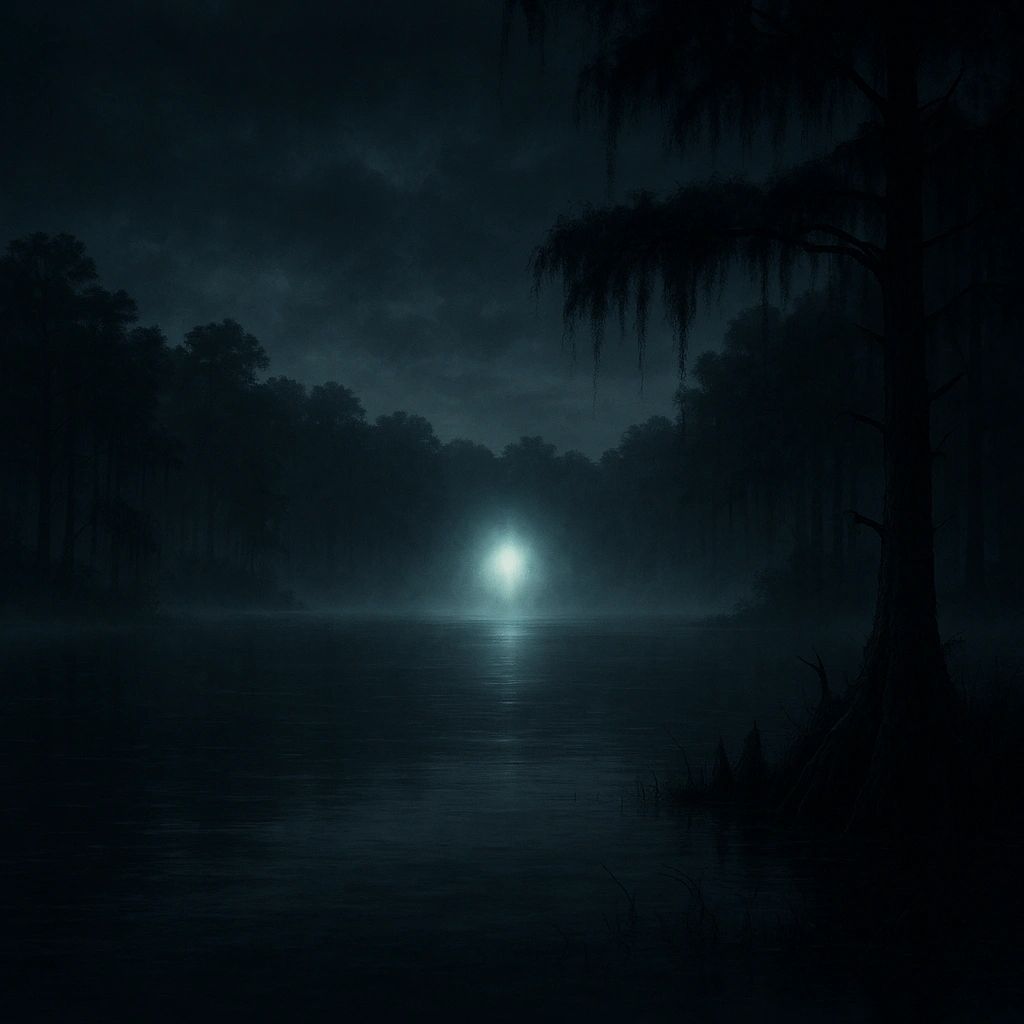
Locals claimed Anderson still tends his post. Fishermen say that on fog-laden nights, a flicker appears over the water—long after the lighthouse was dismantled. They call it The Keeper’s Light.
Boaters who venture too close report sudden ripples on calm water, as if something unseen disturbs the surface. Sometimes they hear faint footsteps or the metallic creak of a lantern chain—though the tower is long gone.
Was it the restless spirit of A. J. Anderson, bound to his lonely duty? Or something older, drawn to tragedy? Whatever the cause, the south end of Lake George carries a reputation that makes even seasoned mariners uneasy.
III. Echoes of the Past Beneath the Surface
Buried History
The St. Johns River system hides layers of the past beneath its silt. Archaeologists and construction crews have uncovered ancient bones and artifacts along its banks, many dating to pre-Columbian times. While these discoveries are treated with respect and care today, for centuries they were simply disturbed and forgotten—sometimes reburied under new soil, sometimes washed into the water.
Local lore holds that Lake George is dotted with burial sites beneath the waves. These aren’t marked graves, but places where the river changed course, swallowing cemeteries or mounds over time.
Night fishermen have reported cold spots—patches of inexplicably chilled water amid the warm lake. One old tale speaks of a diver who surfaced pale and trembling, claiming to have seen “faces in the mud.” Whether hallucination or haunting, the memory remains vivid in local storytelling circles.
IV. The Forest of Secrets
Encircling Lake George is a labyrinth of wilderness—the Lake George State Forest, Ocala National Forest, and several smaller conservation tracts. The terrain shifts between pine flatwoods, cypress domes, and black-water swamps.
During World War II, parts of the nearby forest were used as military bombing practice ranges, leaving craters and debris hidden beneath dense vegetation. Old logging roads snake through overgrown woods. These landscapes create the perfect canvas for the imagination—and perhaps for lingering energies of those who never left.
Campers in the forest recount strange experiences:
- Footsteps pacing outside tents when no one else is nearby.
- Distant lantern-like lights moving between trees before vanishing.
- The sound of paddles dipping into water in the dead of night.
Wildlife experts attribute such experiences to echoing animal sounds and bioluminescent insects, but the uncanny feeling persists.
Some ghost hunters suggest the forest itself acts as a “recording medium”—absorbing human emotion and tragedy, then replaying it as what’s known in paranormal study as a residual haunting.
V. Lake George’s Other Legends
While the Volusia Bar Light story remains its most famous, Lake George harbors several lesser-known tales:
1. The Phantom Canoe
A recurring legend describes a canoe that glides silently across the lake under a full moon. Witnesses say it leaves no wake and vanishes if approached. Some believe it carries the spirits of Timucua hunters who still traverse their ancestral waters.
2. The Drowned Girl
In the 1950s, a young woman allegedly drowned near the Silver Glen Springs inlet while swimming with friends. Since then, swimmers claim to feel a hand brush their ankles or hear muffled laughter from beneath the surface. The story circulates on local fishing forums even today.
3. The Campfire Apparition
Several campers near the western shore have told of an apparition in a tattered long dress wandering near the treeline at dusk. When approached, she vanishes into mist. Paranormal investigators suggest it could be a remnant of pioneer days—a lost settler woman searching for her family.
VI. Science, Psychology, and the Paranormal
The skeptic’s view of Lake George’s hauntings focuses on environmental and psychological factors:
- Mist and fog: The lake’s wide surface produces thick fog banks that distort sound and light.
- Infrasound: Low-frequency vibrations caused by wind and water pressure can trigger unease or even hallucinations.
- Reflections: Moonlight on still water can create phantom images resembling figures or lanterns.
Yet, those who’ve felt the lake’s atmosphere insist there’s more than mere physics at play. Paranormal groups who have visited the region report unusual EMF readings and temperature drops near the old lighthouse site—though scientific verification remains elusive.
VII. The Haunting’s Symbolism
What makes Lake George’s haunting unique is its subtlety. Unlike famous ghost towns or cursed mansions, its eeriness is environmental—woven into nature itself. The haunting of Lake George is less about apparitions and more about presence.
It speaks to Florida’s hidden duality: a paradise built upon forgotten struggle. Every wave and gust of wind carries echoes of people who lived and died here. The lake’s haunting is, in a sense, the land remembering.
VIII. Exploring Lake George’s Haunted Side Responsibly
For those intrigued by the supernatural, visiting Lake George can be both thrilling and enlightening—if done respectfully.
Tips for Responsible Exploration
- Go with a guide or group. The wilderness is vast and disorienting at night. Local eco-tours or night paddles along the St. Johns offer safe experiences.
- Stick to marked trails and public ramps. Much of the land is protected or private. Trespassing not only risks fines but disturbs wildlife.
- Document respectfully. If you photograph or record paranormal evidence, avoid sensationalism. Context matters.
- Respect burial and cultural sites. Many shell mounds are ancient indigenous sacred places. Do not disturb them.
- Stay safe. Florida’s waterways house alligators, snakes, and uneven terrain—treat the real dangers with more respect than the spectral ones.
IX. A Place Between Worlds
When the fog drifts low and the cypress knees protrude like skeletal fingers, Lake George feels like a boundary between worlds—where nature and the supernatural overlap.
Locals say that sometimes, when the night is still, you can hear the faint echo of a bell—the kind once used by lighthouse keepers to warn passing boats. Some say it’s just the wind. Others, that it’s A. J. Anderson, still calling out from beyond the veil.
Standing on the shore, it’s easy to believe that time itself slows here. The water mirrors the sky, the past mirrors the present, and the living mirror the dead.
Maybe Lake George isn’t haunted in the traditional sense. Maybe it’s simply alive—with memory.
X. Final Reflections
The haunting of Lake George in Volusia County is a story of history, tragedy, and enduring mystery. Whether you’re a paranormal believer or a skeptic, this lake demands respect. Its still waters have seen centuries of life and death, and the silence that lingers there is heavy with meaning.
When you next stand by the water’s edge and feel the hair rise on your arms, remember: some places are haunted not by ghosts—but by the weight of everything they’ve witnessed.
Bibliography
- Bartram, John. Journal of Travels into East Florida, 1765–1766. Philadelphia: Historical Society of Pennsylvania.
- Florida Department of Environmental Protection. “Lake George State Forest Management Plan.” Florida DEP, 2021.
- Florida Fish and Wildlife Conservation Commission. “Lake George Cooperative Management Area.” MyFWC.com.
- MyFWC. “Recreation Guide to Lake George Conservation Area.” 2023.
- St. Johns River Water Management District. “Lake George Recreation and Conservation Information.” sjrwmd.com, 2022.
- Volusia County Historical Society Archives. “The Volusia Bar Light and Keeper A. J. Anderson Murder Report.” 1938.
- Encyclopedia of Florida History. Edited by George E. Buker, University Press of Florida, 2015.
- “Volusia Bar Light.” Wikipedia: The Free Encyclopedia. Accessed 2025.
- “Lake George (Florida).” Wikipedia: The Free Encyclopedia. Accessed 2025.
- HauntedPlaces.org. “Haunted Locations in Volusia County, Florida.” Accessed 2025.
- Lake George State Forest Interpretive Trails Guide. Florida DEP, 2019.
- Florida Memory Project. “Historic Photographs of Lake George and the St. Johns River.” FloridaMemory.com.
- Smith, Richard J. “Timucua Burial Practices and Sacred Waters of the St. Johns.” Florida Archaeological Review, Vol. 42, 2018.
- Reynolds, Linda. “Ghost Lights and Lost Keepers: The Spirits of Volusia County.” Daytona Journal, October 2010.
Originally published at the live site .