The Haunting of St. Louis Cemetery No. 1
In the heart of New Orleans, where the air is thick with history and humidity, there stands a place that blurs the line between the living and the dead. The St. Louis Cemetery No. 1, often called the “City of the Dead,” ...
By Rebecca "Madam Chronicler" Ryan
In the heart of New Orleans, where the air is thick with history and humidity, there stands a place that blurs the line between the living and the dead. The St. Louis Cemetery No. 1, often called the “City of the Dead,” is one of the most haunted and storied burial grounds in America. Its crumbling tombs, narrow pathways, and whispering walls have witnessed nearly three centuries of history — and, some say, they still echo with the footsteps and cries of restless souls.
For locals and visitors alike, this cemetery isn’t just a resting place for the departed; it’s a crossroads of legend, religion, and mystery. From the spirit of the infamous Voodoo Queen Marie Laveau to nameless shadows that move among the graves at night, St. Louis Cemetery No. 1 has become a beacon for those who seek the supernatural — or who cannot rest in peace.
The Birth of the City of the Dead
Established in 1789, St. Louis Cemetery No. 1 is the oldest surviving cemetery in New Orleans. It was built to replace St. Peter’s Cemetery, which had become overcrowded and unsanitary. Following a devastating fire that swept through the city that same year, St. Louis Cemetery No. 1 became the final home for countless victims of disease, disaster, and violence.
Because of New Orleans’ high water table, traditional underground burials were impossible — coffins would often float to the surface during floods. To solve this, the city adopted above-ground tombs inspired by Spanish and French burial customs. These ornate stone structures, stacked closely together in a maze-like fashion, earned the cemetery its nickname “the City of the Dead.”
Wandering through its narrow alleys feels like walking through a miniature version of the city itself — small “houses” for the deceased, each etched with names that tell the stories of families, epidemics, and centuries-old tragedies.
But beyond the historical significance, there’s something else that lingers here. A feeling — subtle but undeniable — that you are never truly alone.
The Queen of Voodoo: Marie Laveau
No name is more closely tied to St. Louis Cemetery No. 1 than that of Marie Laveau, the legendary Voodoo Queen of New Orleans. Born around 1801, Marie was a free woman of color who rose to prominence as a powerful Voodoo practitioner, healer, and spiritual advisor.
Laveau’s influence stretched across race and class lines — she served the wealthy and the poor alike, performing rituals that blended African spiritualism with Catholic tradition. Her reputation as a woman of power and mystery grew to mythic proportions, with stories claiming she could heal the sick, control luck, and even see into the future.
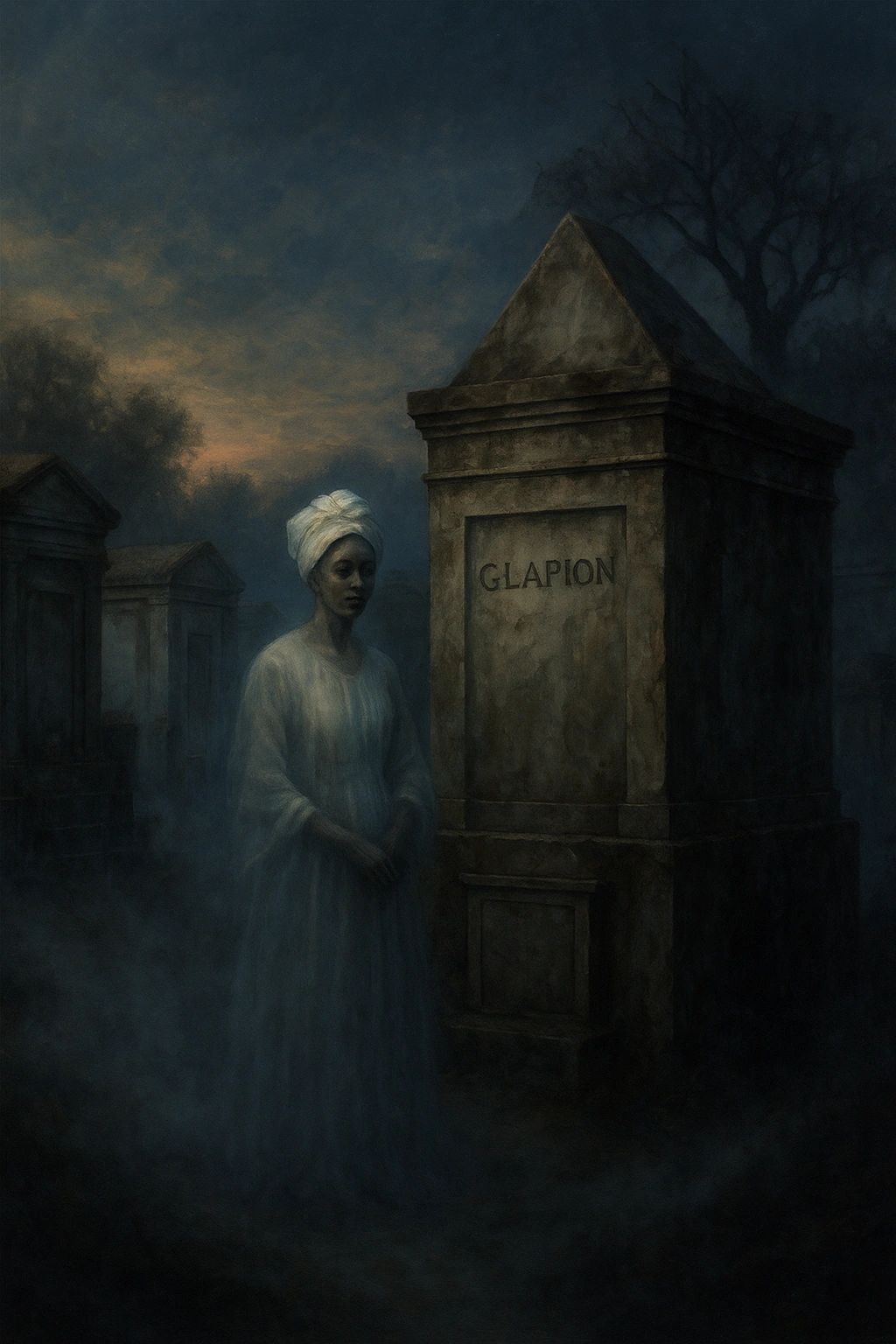
Marie Laveau died in 1881, but her legend didn’t. She was reportedly buried in her family’s tomb within St. Louis Cemetery No. 1, though her exact resting place remains a matter of debate. Some say she was laid to rest in the Glapion family tomb, a tall, weathered structure that has become a site of pilgrimage.
Visitors often leave offerings — coins, beads, candles, and notes asking for her blessing or assistance. For decades, it was common practice to mark three X’s on her tomb as a sign of respect or as a wish-making ritual: one X for the request, one for the offering, and one for gratitude.
However, this tradition led to damage and vandalism, prompting the Catholic Archdiocese to restrict public access. Still, those who enter with guides claim they can feel her presence — a sudden chill, the faint scent of rose water, or the sensation of being watched.
Some witnesses have reported seeing a woman in a bright tignon (headwrap) and long white dress standing quietly near the Glapion tomb. When approached, she vanishes into thin air. Others say they’ve heard her soft humming or the sound of footsteps trailing behind them when no one else is around.
Marie Laveau, it seems, continues to walk among her followers — just as she did in life.
The Phantom of Henry Vignes
Another restless soul said to haunt St. Louis Cemetery No. 1 is Henry Vignes, a sailor whose story is as tragic as it is timeless.
In the early 1800s, Vignes came to New Orleans and stayed in a local boarding house. Trusting by nature, he entrusted the boarding house owner with the paperwork to his family tomb, expecting her to keep it safe. But when he left for sea and later returned, he discovered that the woman had sold his family tomb.
When he died shortly afterward, Henry Vignes was buried in an unmarked grave — a final indignity for a man robbed of his rightful resting place.
Visitors claim to see his ghost wandering the cemetery, described as a tall, pale man with blue eyes and disheveled clothing, asking, “Do you know where my tomb is?” His spirit, it seems, continues to search for the burial place he was denied.
Tour guides often tell of cold spots that appear without warning near certain unmarked plots — and some visitors report their cameras malfunctioning when they try to photograph the area believed to be Vignes’ final resting place.
His presence is not malevolent; rather, it carries a deep sadness, a longing to find peace in a city that forgot him.
The Ghost Bride
Another chilling tale from St. Louis Cemetery No. 1 is that of the Ghost Bride — a woman said to appear in a wedding gown, drifting silently between the tombs.
According to legend, she was a young Creole woman whose wedding day ended in tragedy. Some versions say her fiancé was killed in a duel before the ceremony; others claim she took her own life upon discovering his betrayal. Whatever the truth, her spirit is said to wander eternally, searching for her lost love or the wedding that never came to pass.
Witnesses describe her as eerily lifelike — until she fades away into mist. Some visitors have even reported hearing soft sobbing near the tombs at dusk, only to turn and find no one there.
Photographs taken near the Glapion tomb and the rear sections of the cemetery sometimes show misty white shapes resembling veils or lace, even on clear, humid days. Many believe the Ghost Bride is a remnant of broken promises and heartbreak, bound forever to the place where love turned to loss.
The Yellow Fever Victims
During the 19th century, yellow fever ravaged New Orleans, claiming tens of thousands of lives. The disease struck swiftly and cruelly, often wiping out entire families within days.
St. Louis Cemetery No. 1 became one of the primary burial sites for the epidemic’s victims. The sheer number of dead led to mass interments, with multiple bodies placed in single tombs, sometimes hastily and without ceremony.
Today, paranormal investigators say that the energy from these tragic deaths still lingers. Cold spots, disembodied voices, and flickering lights have been reported in the older sections of the cemetery.
Some visitors describe the unmistakable sensation of being surrounded by invisible figures — a crowded, heavy feeling, as though the dead are still gathered there in mourning. Others claim to have seen ghostly children playing between the tombs, their laughter echoing faintly in the humid air before vanishing altogether.
The Unholy Tombs
Not all spirits within St. Louis Cemetery No. 1 are peaceful. Some, according to local lore, are deeply disturbed.
One infamous story tells of a man known only as Alphonse, a spirit who tries to lure visitors to walk with him through the cemetery. Those who accept reportedly feel a sudden chill or sense of dread as they approach the darker corners of the grounds.
Guides say Alphonse was a victim of betrayal — possibly murdered by a family member — and that he resents being forgotten. People who have left flowers or trinkets on nearby graves have sometimes found them moved or destroyed overnight, as though some unseen force rejected the gesture.
Then there’s the “Devil’s Tomb,” a structure rumored to be cursed. Its occupants are said to have practiced dark rituals, and legends claim that strange symbols occasionally appear on its walls — marks that fade just as quickly as they come. While skeptics dismiss this as graffiti or weathering, locals know better: certain places in New Orleans carry their own kind of darkness, one that doesn’t wash away easily.
The Nicolas Cage Pyramid
One of the more modern oddities of St. Louis Cemetery No. 1 is the nine-foot-tall white pyramid tomb owned by actor Nicolas Cage. Built in 2010, the tomb bears the Latin inscription Omnia Ab Uno — “Everything from One.”
The stark, geometric monument stands in sharp contrast to the aged and crumbling tombs surrounding it. Its presence has stirred controversy among preservationists, but it has also added another layer of intrigue to the cemetery’s lore.
Rumors swirl that Cage built the pyramid to secure his own spiritual protection — or even to connect himself to the mystical energy of the city’s most haunted ground. While he has never publicly explained the reasoning behind it, some tour guides claim that odd things happen near the tomb: electronic equipment fails, voices are caught on recorders, and visitors report the feeling of being watched.
Whether a talisman or a tomb, the pyramid has already become part of the cemetery’s strange mythology — proof that even in modern times, the dead are never far from the living in New Orleans.
When the Gates Close
By day, St. Louis Cemetery No. 1 is hauntingly beautiful — sunlight glinting off whitewashed stone, the scent of flowers and moss in the air, the quiet hum of tour guides sharing tales of the city’s past.
But when the gates close and the sun dips below the horizon, the mood shifts entirely. Locals whisper that after dark, the dead reclaim their city.
Security guards and maintenance workers have reported strange occurrences: shadows darting between tombs, distant voices calling their names, and phantom footsteps that echo long after everyone has left. Some have refused to work the night shift ever again after seeing flickering lights that move like lanterns through the aisles, or hearing laughter that fades into a low, mournful wail.
In 2015, a group of paranormal investigators conducted an overnight study with permission from the Archdiocese. Their instruments recorded unexplained electromagnetic fluctuations, sudden temperature drops, and faint whispers captured on audio — one of which clearly said, “Leave.”
Many who visit the cemetery speak of an overwhelming sense of reverence — and unease. As one local guide put it, “You can feel the weight of centuries here. The dead aren’t gone; they’re just quieter than they used to be.”
Respecting the Dead
St. Louis Cemetery No. 1 is more than a haunted attraction — it’s a sacred space, a fragile relic of New Orleans’ past. In 2015, the Archdiocese restricted public access to protect the site from vandalism and overcrowding. Now, visitors must enter with a licensed tour guide.
This measure has helped preserve the delicate tombs and maintain respect for those interred there. But it has also heightened the aura of mystery — because not everyone can wander these paths freely anymore. Those who do often describe a powerful emotional experience, as though stepping through a veil into another world.
It’s a reminder that New Orleans has always lived alongside its ghosts — in its music, its faith, and its folklore. The people here don’t just tell ghost stories; they share them like family histories, because in many ways, they are.
The Eternal City of Spirits
There’s a reason St. Louis Cemetery No. 1 has endured as one of the most famous haunted sites in the world. It embodies everything that makes New Orleans unique — the blending of cultures, the coexistence of faith and superstition, the beauty that lives hand-in-hand with decay.
Its walls hold stories of love and betrayal, of miracles and curses, of lives lived passionately and lost too soon. And perhaps that’s why so many spirits linger here: because New Orleans itself has never learned how to let go.
To walk through the City of the Dead is to walk through time — and perhaps, if you listen closely, through the whispering souls who refuse to be forgotten.
Whether you believe in ghosts or not, there’s no denying that St. Louis Cemetery No. 1 hums with energy — a heartbeat beneath the marble, a sigh in the air.
And when the wind rustles through the willows and the church bells toll in the distance, you can almost hear them calling: Welcome to New Orleans. Welcome to the City of the Dead.
Bibliography
- Long, Carolyn Morrow. A New Orleans Voudou Priestess: The Legend and Reality of Marie Laveau. University Press of Florida, 2006.
- Campanella, Richard. Geographies of New Orleans: Urban Fabrics Before the Storm. University of Louisiana Press, 2006.
- Smith, Katherine. “The Haunted Cemeteries of New Orleans.” Louisiana Folklife Journal, 2019.
- May, W. Chris. Ghosts of New Orleans: The City’s Haunted Past. Pelican Publishing, 2013.
- Roberts, Christine. “The Spirits of St. Louis Cemetery No. 1.” Haunted America Tours, 2021.
- Ransom, Jonathan. Legends and Lore of the Crescent City. Arcadia Publishing, 2018.
About the Author
Rebecca “Madam Chronicler” Ryan is a writer and researcher for The Chronicler Library. She is the co-creator of The Chronicle of Fear and The Waterline Chronicles, and a lead researcher and contributor for The Captain’s War Chronicles and The Captain’s Cellar. Her work blends myth, history, and the natural world with empathy, insight, and intellectual rigor.
Originally published at the live site .