
The Haunting of the Old Absinthe House in New Orleans
There are few cities in America where the line between the living and the dead blurs quite like it does in New Orleans. From the moss-draped oaks of the Garden District to the shadowed alleys of the French Quarter, whisp...
By Rebecca "Madam Chronicler" Ryan
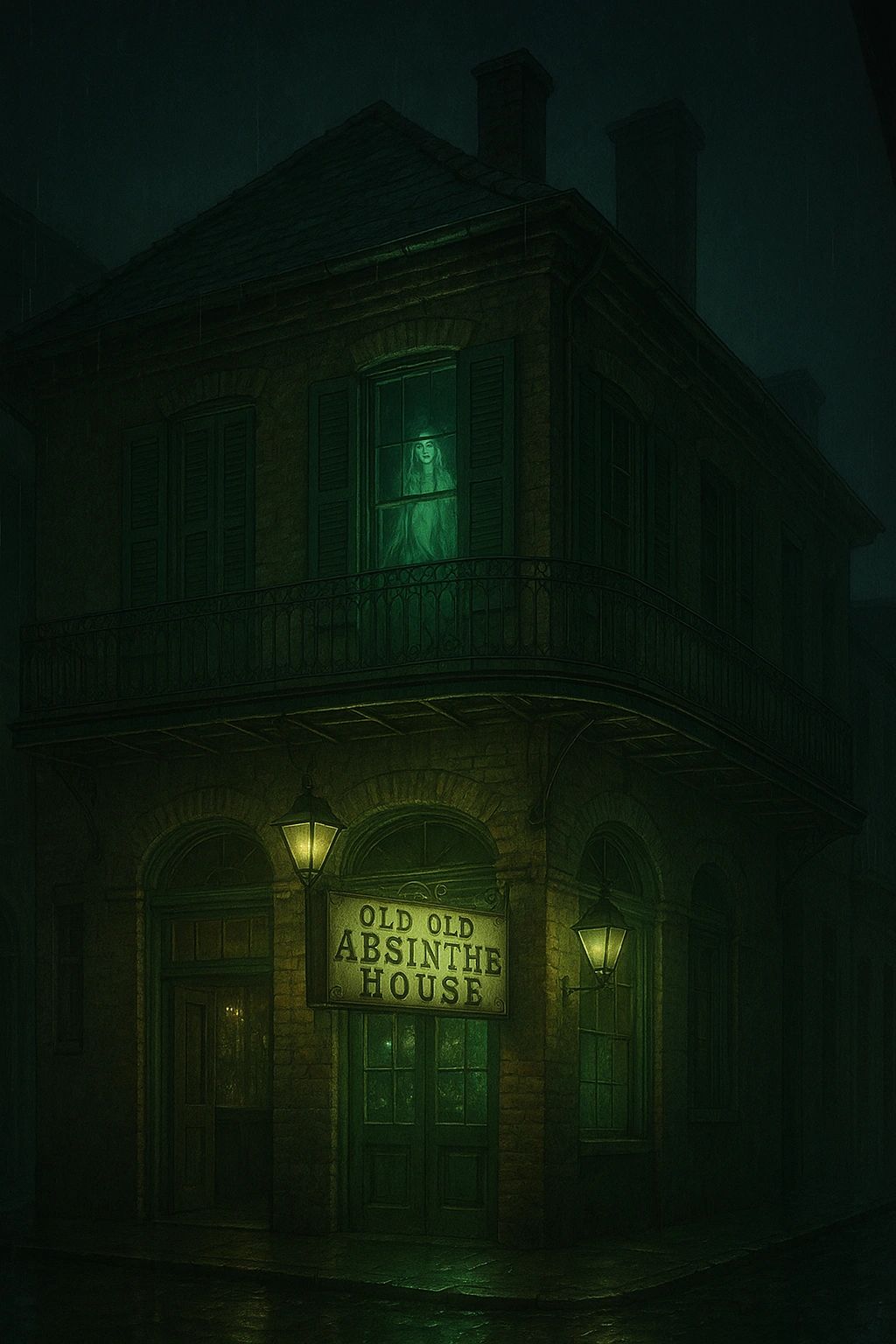
There are few cities in America where the line between the living and the dead blurs quite like it does in New Orleans. From the moss-draped oaks of the Garden District to the shadowed alleys of the French Quarter, whispers of the supernatural seem to echo in every courtyard and cobblestone. Yet even in this city of ghosts, one establishment stands apart — a place where history, myth, and the restless dead intertwine over the green haze of an infamous drink.
Welcome to The Old Absinthe House — a bar that has seen centuries of secrets, seduction, and spirits both bottled and beyond.
A House Built on Spirits and Sin
The Old Absinthe House, located at 240 Bourbon Street, is more than just a historic watering hole. It’s a living relic, a time capsule that has watched New Orleans rise, burn, rebuild, and revel. The building itself dates back to 1806, originally constructed as a corner grocery store by two Spanish merchants, Pedro Front and Francisco Juncadelia.
But like much in the French Quarter, its destiny was never ordinary. By the 1830s, it had transformed into a bustling bar known as The Absinthe Room, and it quickly became the heart of New Orleans nightlife — a den of bohemian debauchery, filled with laughter, music, and the swirling green elixir that gave the place its name.
Absinthe, known as “the Green Fairy,” was more than a drink. It was a ritual. The sugar cube, the dripping water, the swirling transformation of the emerald liquid — it was intoxicating, mysterious, and, to many, dangerous. Writers, artists, and travelers from all over the world flocked here to taste the forbidden. The absinthe craze made the bar famous, but it also gave rise to something darker — a kind of madness that seemed to seep into the very walls.
Pirates, Politics, and the Pact at the Absinthe House
The Old Absinthe House’s most famous legend centers not around ghosts, but around pirates and patriots. According to local lore, in 1815, the privateer Jean Lafitte met secretly with General Andrew Jackson in a dimly lit upstairs room.
The War of 1812 had reached New Orleans, and the British were poised to strike. Jackson, desperate for aid, struck a deal with Lafitte and his band of outlaws. In exchange for pardons, Lafitte’s men would help defend the city. Together, they led a decisive victory at the Battle of New Orleans — and sealed their fates as legends.
It is said that the ghost of Jean Lafitte still returns to the Old Absinthe House, drawn to the very table where that fateful meeting occurred. Bartenders have reported the scent of tobacco and sea salt lingering in the air when no one is smoking. Glasses slide across the counter, chairs creak as if someone invisible takes a seat, and sometimes — late at night — a man in a wide-brimmed hat and 19th-century coat appears briefly in the corner before vanishing into the shadows.
They call him The Pirate of Bourbon Street.
And those who have seen him say his eyes glint like wet obsidian beneath the flickering bar lights.
Echoes of the Green Fairy
By the mid-1800s, the Old Absinthe House had become the epicenter of bohemian culture in New Orleans. Artists, writers, poets, and misfits of all kinds came to chase the Green Fairy — and perhaps, to escape themselves.
But absinthe was said to have a mind of its own. Some claimed it opened doors — not just of creativity, but of perception. And maybe, just maybe, of the otherworldly.
Many who’ve worked or drank there tell stories of strange happenings tied to the absinthe itself. Glasses have been seen refilling on their own. Patrons report a shimmering green glow in mirrors, especially after hours. Others describe hearing whispers — French, Spanish, and Creole voices murmuring words no one can quite understand.
One former bartender told of locking up late one night, only to hear the distinctive sound of a cork popping. He turned, and there it was — a bottle of absinthe open on the counter, half full, condensation forming as though it had just been poured.
He left it there.
When he returned in the morning, the bottle was empty.
The Lady in Green
Among the many spirits said to haunt the Old Absinthe House, none are more tragic than The Lady in Green.
Her story dates back to the late 19th century, when a young Creole woman named Marguerite Delphine was said to have been a regular patron. Known for her beauty and her emerald silk dress, she became infatuated with a French artist who frequented the bar. They were inseparable for a season — until he disappeared, allegedly fleeing back to Paris to escape his debts.
Heartbroken, Marguerite returned night after night, drinking absinthe alone at the corner table where they once sat. One cold February evening, she was found dead in that very spot — her emerald dress soaked with spilled absinthe, her heart stopped before the glass touched her lips.
To this day, staff and visitors report sightings of her — a woman in a flowing green gown gliding up the staircase or sitting silently in the corner, her translucent form barely visible in the flickering candlelight. Some say the air turns colder when she appears; others claim they’ve seen tears shimmer down her pale cheeks before she fades into nothing.
They call her The Lady in Green, a spectral reflection of absinthe’s allure and sorrow — forever chasing a love lost to time.
The Upstairs Room: Shadows and Secrets
The second floor of the Old Absinthe House is where most of the hauntings are said to occur. Once used for private meetings and parties, it now serves as a space steeped in history — and supernatural energy.
Guests who have attended events upstairs report strange sensations: sudden drops in temperature, a feeling of being watched, and disembodied footsteps pacing across the old wooden floor. Lights flicker, doors creak open on their own, and faint laughter — distinctly female — echoes from corners where no one stands.
Paranormal investigators have captured EVPs (electronic voice phenomena) that sound like overlapping conversations in French and English. Some claim to have recorded a gruff male voice whispering “Jackson… Lafitte…” — as if reenacting that legendary meeting long after death.
Others have seen the shadow of a man standing near the fireplace — tall, broad-shouldered, with a faint outline of a saber at his hip. When approached, he vanishes into thin air, leaving behind the faint scent of tobacco and saltwater.
The Bartenders’ Tales
Few know the spirits of the Old Absinthe House better than those who serve them.
Over the years, countless bartenders have shared their experiences — tales whispered among staff with a nervous laugh and a knowing glance.
One longtime employee, known only as “Mack,” recalled a night when the cash register began to ring on its own after closing. He approached the counter, expecting a malfunction — only to see the register drawer open and close three times, each time more forcefully, before stopping. When he turned off the lights, he heard a man’s voice behind him say, “Leave the light on, boy.”
He left it on.
Another bartender described hearing the sound of clinking glasses and laughter long after everyone had gone home. When he looked toward the mirror behind the bar, he saw a reflection of the room filled with 19th-century patrons — women in lace dresses, men in waistcoats — all toasting, drinking, and dancing. When he turned around, the bar was empty.
And yet, in the mirror, the party continued.
A City That Never Lets Go
The Old Absinthe House is not unique in being haunted — at least not by New Orleans standards. The French Quarter itself is a labyrinth of restless souls, where every doorway hides a story and every breeze carries the echo of the past. But what makes this bar so chillingly alive is that it still thrives.
Night after night, the laughter of tourists mingles with the whispers of the dead. The absinthe still flows, the music still plays, and in between the revelry, something unseen stirs — as if the walls themselves are breathing.
It’s said that the ghosts here aren’t malicious. They’re more like echoes of a city that refuses to die. A city that drinks, dreams, and dances with its dead.
Perhaps the Old Absinthe House endures because it has always been a crossroads — of culture, history, and the supernatural. A place where pirates plotted with generals, where artists chased visions through the haze of absinthe, and where the lost souls of New Orleans find refuge among the living.
The Green Fairy’s Curse
For decades, absinthe itself was banned — accused of driving men mad, of inspiring murder, and of corrupting society. In 1912, the U.S. outlawed it entirely. But in New Orleans, the memory of the Green Fairy never truly faded.
Some locals whispered that the ban was less about morality and more about fear — fear of what the drink revealed. The hallucinations it caused weren’t madness, they said, but glimpses into another realm. The Green Fairy didn’t just intoxicate you — she opened your eyes.
When absinthe returned to the shelves in the early 2000s, bartenders at the Old Absinthe House revived the traditional ritual — the glass, the sugar cube, the drip of ice-cold water. Tourists came in droves to experience the legendary drink. But a few claimed the experience went too far.
One patron swore that after his second glass, he saw a man in old naval garb sitting beside him. Another said that when she looked into her glass, she saw a woman’s face staring back — weeping green tears.
It’s said that those who drink too much absinthe in that old bar risk seeing more than they bargain for. Some leave shaken. Others never speak of it again.
When the Lights Go Out
Every haunted building has its witching hour — that liminal time between midnight and dawn when the air feels thicker and the world grows still. For the Old Absinthe House, that hour begins just after 3 a.m.
When the last patrons leave and the staff begins to close up, strange things happen. Lights turn back on after being switched off. The scent of anise and burnt sugar fills the air. And sometimes, a soft piano melody can be heard drifting down from the second floor — even though there’s no piano in the building.
Several witnesses have claimed to see a candlelight glow flicker in the upstairs window long after the bar is empty. Those brave enough to investigate often find nothing but cold air and the faint impression of footprints in the dust.
It’s as if the spirits of the Old Absinthe House keep their own hours — pouring their drinks and telling their tales long after the living have gone home.
The Modern Pilgrimage
Today, the Old Absinthe House remains one of the most visited bars in New Orleans. Its iconic façade — wrought iron balcony, weathered shutters, and glowing lanterns — has become a symbol of the French Quarter’s undying charm.
Visitors come for the history, the absinthe, and the chance to glimpse something beyond the veil. Paranormal tours stop by nightly, and countless photos show strange anomalies: floating orbs, translucent figures, and faint green streaks of light near the mirrors.
Some say it’s just tricks of the camera — reflections, dust, or coincidence. Others believe the ghosts of the Old Absinthe House still enjoy being seen.
After all, what is a haunting if not a desire to be remembered?
A Toast to the Dead
If you ever find yourself walking down Bourbon Street after midnight, pause when you reach the corner of Bienville. Look up at the glowing sign of the Old Absinthe House and listen closely.
You might hear laughter echoing from the second floor, or the faint clink of a glass raised in toast. Step inside, and order an absinthe the old way — slow, ritualistic, reverent. As the water drips through the sugar cube and the liquid turns from emerald to opalescent white, think of all the souls who have done the same over the centuries.
Jean Lafitte. Andrew Jackson. Marguerite Delphine. The nameless poets, pirates, and dreamers who found solace — or madness — within those walls.
Then raise your glass to them.
Because in New Orleans, the dead are never far away. And in the Old Absinthe House, they might just be sitting beside you — sipping slowly, smiling faintly, and waiting for you to notice.
Bibliography
- “Haunted New Orleans: The Spirits of the French Quarter.” Louisiana Folklore Journal, 2018.
- Klein, Richard. The Green Fairy and the Crescent City: Absinthe Culture in New Orleans. University of Louisiana Press, 2015.
- Sublette, Ned. The World That Made New Orleans: From Spanish Silver to Congo Square. Chicago Review Press, 2008.
- “Jean Lafitte and the Battle of New Orleans.” National Park Service Archives, 2020.
- “Ghosts of Bourbon Street.” New Orleans Historical Society Quarterly, Vol. 42, 2019.
- Davis, Carol M. Haunted Bars of the French Quarter. Crescent City Publishing, 2021.
- Eyewitness accounts collected by Haunted History Tours of New Orleans, 2022–2024.
About the Author
Rebecca “Madam Chronicler” Ryan is a writer and researcher for The Chronicler Library. She is the co-creator of The Chronicle of Fear and The Waterline Chronicles, and a lead researcher and contributor for The Captain’s War Chronicles and The Captain’s Cellar. Her work blends myth, history, and the natural world with empathy, insight, and intellectual rigor.
Originally published at the live site .