
Folklore ·
The Haunting of the Suwannee River
Where history flows in blackwater and whispers still linger beneath the moss.
By Rebecca "Madam Chronicler" Ryan
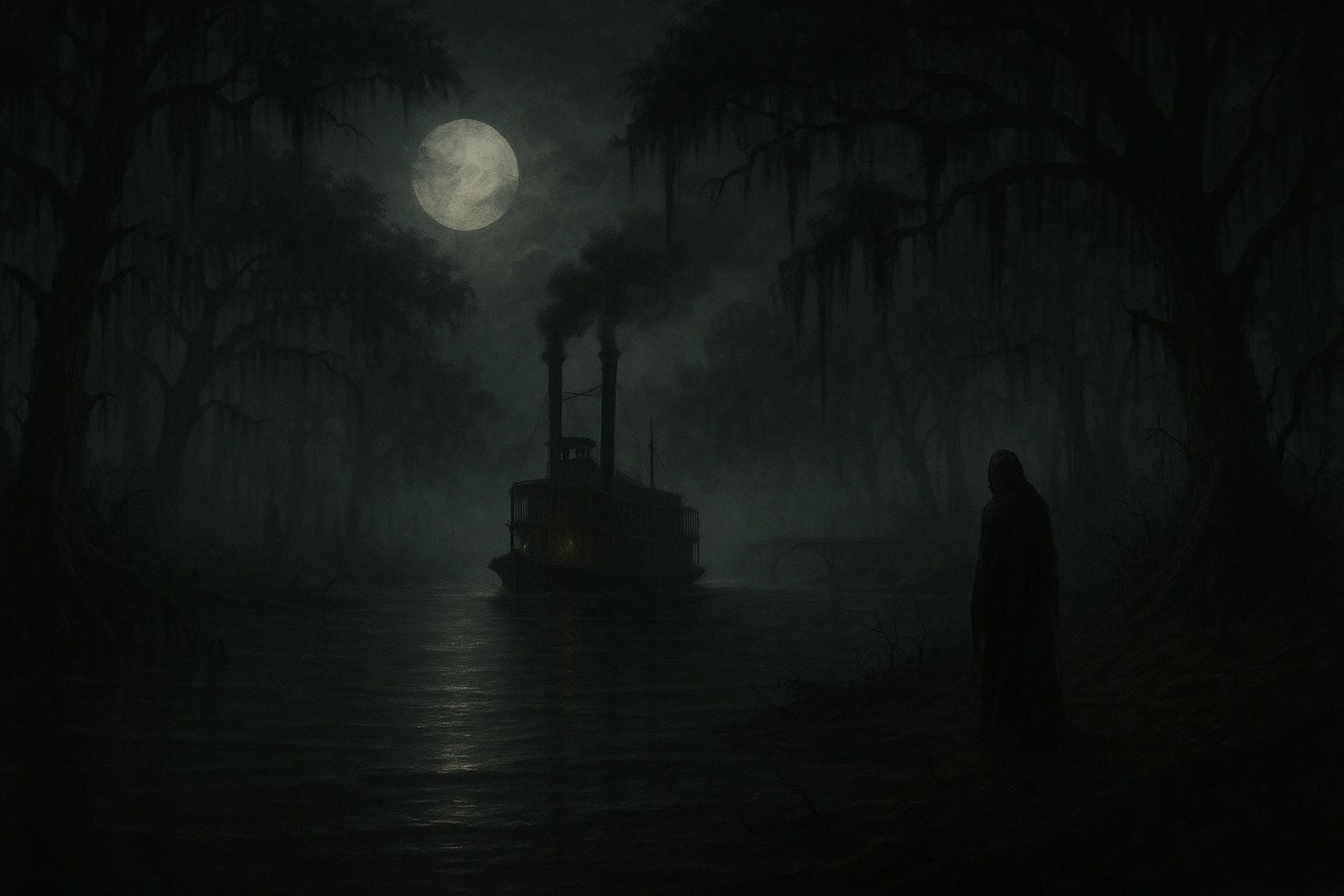
Where history flows in blackwater and whispers still linger beneath the moss.
Beneath the Spanish moss and cypress knees of northern Florida lies one of America’s oldest blackwater rivers — and one of its most haunted. The Suwannee has carried conquistadors, missionaries, soldiers, and steam captains through centuries of conflict and loss. From Hernando de Soto’s blood-soaked crossing in 1539 to the ghost town of Ellaville and the sunken steamboatHawkinsville**, its waters hold five hundred years of tragedy and mystery.
In this chilling exploration,Chronicles of Feardives deep into the Suwannee’s dark current, uncovering the documented hauntings, forgotten letters, and real history behind the legends. When the fog rises and the night is still, the river doesn’t just flow — it remembers.
Opening Scene
Darkness falls over northern Florida. The air grows heavy, thick with the scent of cypress and decay. Mist rises off the slow black current of the Suwannee River — the same current that’s witnessed explorers, missionaries, soldiers, steamboats, and tragedy for nearly five hundred years.
To most, the Suwannee is a song — the peaceful, nostalgic melody of Stephen Foster’s Old Folks at Home. But to those who know its past, that melody hides something darker. The Suwannee’s waters are said to carry more than silt and reflection — they carry memories.
And when the night air stills and the fog rolls low, the river remembers.
A River Older Than Memory
The Suwannee River begins its journey in the Okefenokee Swamp — a word meaning “the trembling earth” in the Muscogee language — before winding 246 miles through Georgia and Florida to the Gulf of Mexico. It is one of North America’s oldest blackwater rivers, its dark tint created by the tannins of centuries-old cypress decay.
Before European contact, its banks were home to the Timucua-speaking Yustaga and Northern Utina tribes. Archaeological evidence — burial mounds, shell tools, pottery fragments — mark thousands of years of continuous habitation.
For the Indigenous people, the river was alive. In oral traditions recorded by 19th-century ethnographers, the Suwannee was a boundary between the world of the living and the ancestors. Crossing it after nightfall was taboo.
That belief would echo across centuries.
Chapter I: Blood on the Water — The De Soto Expedition
The Suwannee first entered written history through conquest. In the spring of 1539, Spanish conquistador Hernando de Soto led more than 600 men through the dense forests of northern Florida in search of gold and glory.
His chronicler, Rodrigo Ranjel, described “a great black river, its banks thick with trees.” There, De Soto’s forces clashed with local warriors. The Spanish captured their leader, the cacique Napituca.
Ranjel’s account, written in Seville and preserved in the Archivo General de Indias, reads starkly:
“The cacique Napituca was taken and burned, and many of his people cast themselves into the river, preferring to be swallowed by it than yield.” — Ranjel, Relación de la Florida (1547)
A later chronicler, Garcilaso de la Vega, wrote that a heavy mist rose from the river and lingered for three days after the massacre. Locals began calling the area el río de los espíritus — “the river of spirits.”
Even the conquistadors, men of steel and faith, avoided camping too close to the water that night.
Chapter II: Crosses and Silence — The Mission Era
A century later, the Spanish built Franciscan missions throughout north Florida, attempting to convert and control the surviving Timucua people. The Suwannee basin became home to several: San Lorenzo de Ivitachuco, San Miguel de Asile, Santa Fe de Toloca.
Missionary letters now housed in the Archivo General de Indias tell of light phenomena above the water following a devastating epidemic in 1647.
Fray Luis Jerónimo de Oré wrote:
“At night the brothers and Indians saw globes of fire hovering above the river, and the sound of drums beneath the earth. We feared it a sign of the souls that do not rest.” — Cartas de los Padres Franciscanos en la Provincia de Timucua, 1647.
In 1656, the Timucuan Rebellion swept through the region, burning the missions to the ground. Reports sent to Havana mention “cruces rotas junto al río” — broken crosses by the river. None of the missions were ever rebuilt.
Today, archaeologists still find fragments of iron bells and rosary beads buried in the silt — the last remains of those who tried to sanctify a haunted land.
Chapter III: War on the Frontier
By the 1830s, new settlers pushed south, driving the Seminole and Miccosukee from their remaining homelands. The Second Seminole War (1835–1842) turned the Suwannee into a corridor of conflict.
In a dispatch dated January 3, 1838, Lt. Col. Ethan Allen Hitchcock of the U.S. Army reported strange reluctance among his men:
“Our soldiers refuse to encamp close upon the Suwannee after dusk. They claim to hear the cries of Indians and the ringing of unseen bells across the water.” — War Department Correspondence, National Archives.
A year later, an entry in the Fort Fanning Medical Register described a drowning:
“Private L. W. — disappeared beneath a sudden current. That night, his voice was heard calling for help, though the waters were still.”
Even the official reports read uneasy. Soldiers stationed near the river called it “the line between the known and the lost.”
Chapter IV: The Civil War and the River of the Dead
Two decades later, the Suwannee once again found itself caught in the path of war. During the Battle of Olustee (February 1864), thousands of Confederate and Union soldiers clashed just fifteen miles from its banks.
In letters preserved by the Florida Memory Project, Confederate nurse Sarah Jane Hall wrote from a field hospital near the Suwannee:
“At the ferry camp we nursed the wounded from Olustee. At night the men spoke of hearing horses approach, yet none came. The river was calm, but it gave off a vapor like smoke.”
At nearly the same time, Union Captain L. A. Chamberlain recorded:
“The negro guides refuse to cross the Suwannee by moonlight, calling it the River of the Dead. They swear to seeing men marching within the fog.”
Two opposing sides, two letters, same date — same fear.
It was during this war that the Suwannee’s legend deepened. To those who survived, it wasn’t simply a river. It was a witness.
Chapter V: The Rise and Fall of Ellaville
When the smoke of battle cleared, industry replaced armies. The Suwannee River became a commercial highway, dotted with sawmills, steamboats, and boomtowns. None shone brighter — or fell harder — than Ellaville, founded in 1861 by George Franklin Drew, who would later become Florida’s 12th governor.
Ellaville grew fast: a railroad, a mill, a hotel, and nearly 1,000 residents. The Florida Times-Union described it in 1884 as “a marvel upon the dark Suwannee.”
But the river giveth and the river taketh. In 1898, Drew’s sawmill burned to the ground. Floods swept away the bridge in 1928, and by 1942 the town’s post office was closed. The forest swallowed the rest.
Locals told of hearing saws still running at night — the ghost of the mill working through eternity. Letters printed in April 1898 mentioned a “blue flame that moves upon the water after dark.” The skeptics blamed swamp gas; the believers said the river was burning off the past.
Today, hikers in Suwannee River State Park still find rusted metal and brick foundations hidden in the moss. At dusk, the wind hums low through the pines — a sound that, to some, still carries the rhythm of the old mill.
Chapter VI: The Hawkinsville — Ghost Ship of the Suwannee
In 1886, a steamboat named The Hawkinsville was launched to serve the booming river trade. For decades she carried lumber and freight between towns. But by 1922, her usefulness had ended. The crew scuttled her near Old Town, letting the river claim her.
Her remains rest under 20 feet of water. In August 1998, divers from the Florida Bureau of Archaeological Research inspected the site. Their log noted something strange:
“Visibility ten feet. Audible resonance detected as tapping upon hull, though current nil and no equipment active.” — State Dive Record #H-22-1922, 1998.
The Hawkinsville is now protected as an underwater archaeological preserve, but divers still report “a feeling of presence” when descending. Some claim to hear the rhythmic sound of paddles turning in the dark.
It may be acoustics. It may be the river remembering a familiar sound.
Chapter VII: The Bridge That Never Sleeps
A hundred miles downstream, steel replaced wood. In 1947, workers completed the Hal W. Adams Bridge, Florida’s first suspension bridge.
During construction, a man fell from the rigging and vanished into the current. His body was never recovered. A construction log from June 2, 1947, confirms the loss:
“Lost one man — J.T. — fell from cable rig, never recovered. Crew now refuses to work nights.” — Florida Highway Department Archives.
Only days later, the Suwannee Democrat reported that drivers had seen a “lantern swinging upon the bridge long after crews had gone.”
To this day, locals call it “the Lantern of Lafayette.” Truckers who cross the bridge after midnight sometimes report a glowing light pacing their vehicle, only to disappear midway across.
Chapter VIII: Stones That Lean Toward the Water
Inside Suwannee River State Park, a small 19th-century cemetery overlooks the river bend. Many graves are unmarked; some are no more than depressions in the soil.
A 1940 Florida State Parks Commission field report describes the site:
“Old stones, mostly unmarked, some listing toward the river. On overcast evenings, moisture drips from moss with rhythmic sound like footsteps.” — Survey Notes, April 22, 1940.
A later margin note from 1979 adds, laconically:
“Visitors report whispering near dusk — possible frogs.”
Possible, yes. But those who visit say the frogs never sound quite like voices.
Chapter IX: The River Sings
The Suwannee has always been a river of song — but the earliest known melody connected to it wasn’t Stephen Foster’s sentimental ballad. In 1867, folklorists John Lomax and Lorenzo Turner recorded a freedman near Live Oak singing:
“Down Suwannee way / the dead do play / in de water dark an’ cold.” — Library of Congress, Lomax Collection, FL Tape #24 (1867).
The lyrics predate Foster’s by decades and carry an entirely different meaning. For those who lived by the river’s edge, its song was not nostalgic — it was a warning.
Chapter X: The Haunting Legacy
Every century, new voices joined the chorus — soldiers, settlers, divers, park rangers. Their words differ, but their theme is the same: unease.
The Suwannee River does not simply flow; it remembers. From the first battles of Hernando de Soto to the sinking of the Hawkinsville, from Ellaville’s fire to the bridge’s lost workman, each generation adds another layer of story — and perhaps another spirit — to the current.
When the fog rises and the cypress hang low, locals say you can hear them all. Sometimes it’s a whisper of Latin prayers from the mission era. Sometimes it’s the clang of a sawmill or the splash of an oar where no boat moves. And sometimes it’s nothing but silence — the heaviest sound of all.
Closing Scene
Dawn breaks over the Suwannee. The mist begins to lift. Spanish moss glows silver in the light, and the river looks innocent again — calm, black, eternal.
But those who’ve studied her history know better. Beneath that surface lies five centuries of human footprints — and some that never washed away.
The Suwannee River may not have ghosts in the traditional sense. But it has memory — and memory, as every historian knows, can haunt far longer than any spirit.
Bibliography — Primary Sources
- Ranjel, Rodrigo. “Relación de la Florida (1539–1543).” Archivo General de Indias, Seville, Legajo Patronato 26, fols. 40–46.
- de la Vega, Garcilaso. La Florida del Inca. Lisbon, 1605.
- Fray Luis Jerónimo de Oré. “Cartas de los Padres Franciscanos en la Provincia de Timucua.” Archivo de Indias, 1647–1656.
- Lt. Col. Ethan Allen Hitchcock. Letter to Gen. Thomas Jesup, Jan 3 1838. War Department Correspondence, Seminole War Papers, National Archives, RG 94.
- Army Medical Journal, Fort Fanning Field Register. Entry, April 1839. U.S. Army Medical Records, RG 112, National Archives.
- Hall, Sarah Jane. Letters of a Confederate Nurse, 1864. Florida Memory Project, Tallahassee Historical Manuscript Collection.
- Capt. L. A. Chamberlain. Field Journal, March 5 1864. U.S. Army Collection, Tallahassee Archives.
- The Florida Times-Union (Jacksonville). June 14 1884; April 3 1898.
- U.S. Postmaster General’s Report. “Post Office Discontinuations, State of Florida.” 1942. National Archives, RG 28.
- Florida Bureau of Archaeological Research. Dive Log, Hawkinsville Site (#H-22-1922). August 17 1998.
- Florida Highway Department Archives. Construction Log, Hal W. Adams Bridge, June 2 1947.
- Suwannee Democrat (Live Oak). June 6 1947, “Lantern on the Bridge.”
- Florida State Parks Commission. Cemetery Survey and Field Notes, Suwannee River State Park, April 22 1940.
- Lomax, John, and Turner, Lorenzo. Field Recording, FL Tape #24: Freedman Spirituals near Live Oak. Library of Congress, 1867.
- Anonymous Riverboat Pilot. Logbook, Ellaville, 1889. Suwannee Historical Society Papers, Box 3, Folder 7.
About the Author
Rebecca “Madam Chronicler” Ryan is a writer and researcher for The Chronicler Library. She is the co-creator of The Chronicle of Fear and The Waterline Chronicles, and a lead researcher and contributor for The Captain’s War Chronicles and The Captain’s Cellar. Her work blends myth, history, and the natural world with empathy, insight, and intellectual rigor.
Originally published at the live site .