
Folklore ·
The Rougarou of Bayou Lafourche
Discover the terrifying legend of the Rougarou of Bayou Lafourche — Louisiana’s werewolf-like swamp creature that prowls the bayous, punishing sinners and haunting Cajun folklore for generations.
By Rebecca "Madam Chronicler" Ryan
When the Bayou Falls Silent
In the heart of Louisiana’s swamplands, when the bullfrogs stop croaking and the night turns still, locals know to keep their voices low. Something ancient moves through the mist of Bayou Lafourche — a creature as much a part of Cajun folklore as gumbo and ghost stories.
They call it the Rougarou — the werewolf of the bayou.
This shapeshifting monster is said to haunt the waterways from Thibodaux to Golden Meadow, emerging from the shadows to punish those who break their faith, betray their community, or wander too far from the light.
But what is the Rougarou of Bayou Lafourche, really? A myth born of fear? A religious warning? Or a creature still lurking beneath the cypress trees?
Let’s dive deep into the Louisiana legend that refuses to die.
What Is the Rougarou?
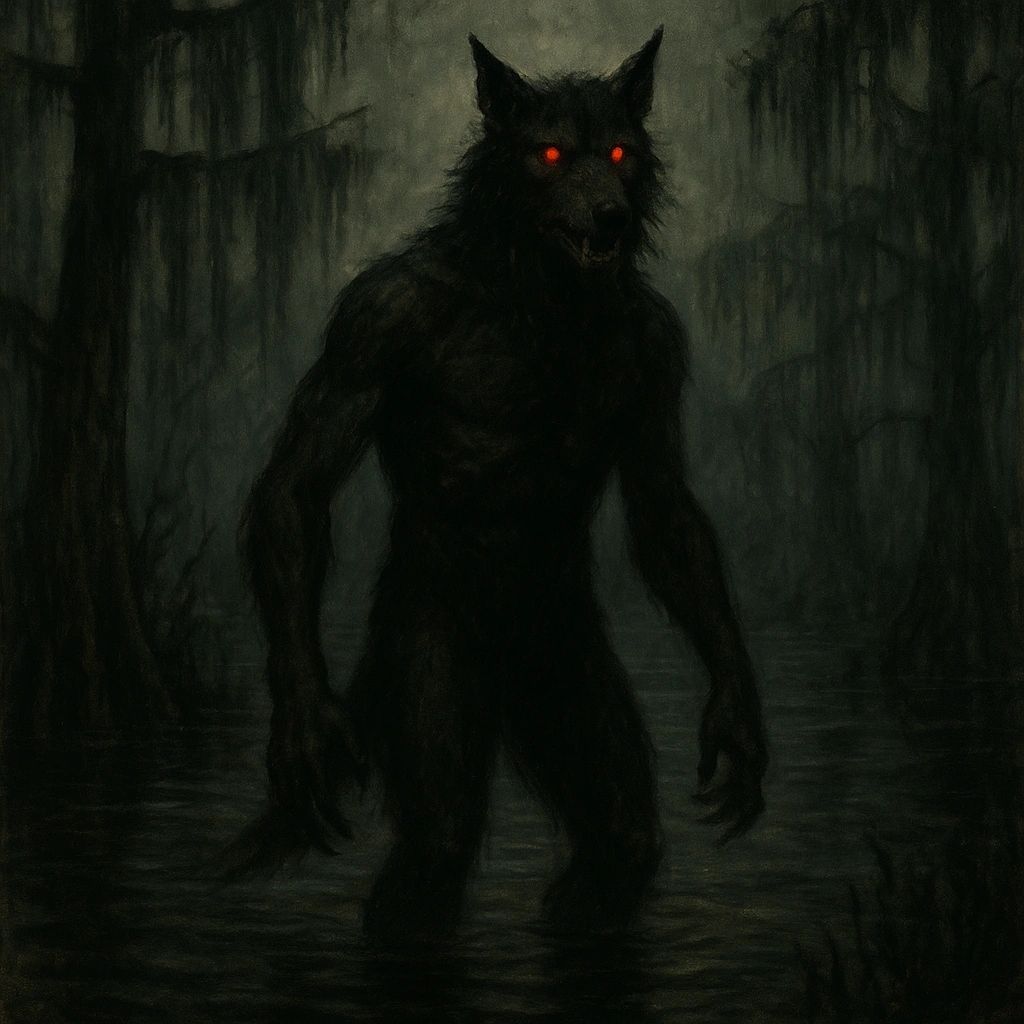
The Rougarou — sometimes spelled Rugaru or Loup-Garou — is Louisiana’s version of the French werewolf myth. In Cajun and Creole folklore, it’s described as a tall, muscular creature with the body of a man and the head of a wolf or dog, covered in matted fur and glowing red eyes.
According to tradition, the Rougarou stalks the swamps, sugarcane fields, and bayous of south Louisiana, hunting those who sin, skip church, or fail to respect the customs of their ancestors.
Some call it a curse. Others, a warning.
Either way, in the darkness of Bayou Lafourche, few dare to say its name aloud.
Origins: The French Loup-Garou Becomes Cajun
The Rougarou’s origins trace back to France, where tales of the loup-garou — literally “wolf-man” — terrified villagers for centuries. These old European stories told of cursed men who transformed under the full moon, often as punishment for wicked deeds.
When French settlers and Acadians arrived in Louisiana in the 1700s, they brought these myths with them. But Louisiana was a world apart — humid, wild, and filled with the cries of creatures unseen.
Here, the European wolf met the swamp’s primal power. Over generations, French Catholicism blended with African, Caribbean, and Native American folklore, giving birth to something new — a uniquely Cajun creature of judgment and transformation.
Thus, the loup-garou evolved into the Rougarou of Louisiana — a beast shaped by faith, fear, and the ever-shifting shadows of the bayou.
Bayou Lafourche: Home of the Beast
Flowing for more than 100 miles from the Mississippi River to the Gulf of Mexico, Bayou Lafourche is often called “the longest Main Street in the world.” It winds through towns like Thibodaux, Labadieville, and Golden Meadow, carrying not just water — but centuries of story.
For locals, Bayou Lafourche isn’t just a setting. It’s a living character — a place of both life and mystery. And in its tangled waterways and moss-draped cypress trees, the Rougarou feels right at home.
Many claim that the Rougarou still roams these wetlands, appearing to lone fishermen, hunters, or travelers who dare the swamp at night.
The Rougarou’s Appearance and Powers
Descriptions of the Rougarou vary from parish to parish, but the image most often shared in Lafourche folklore is chillingly consistent:
- A towering humanoid figure, often over seven feet tall
- Covered in coarse, black fur slicked with swamp water
- A wolf or dog’s head, with elongated jaws and razor teeth
- Eyes that glow red in torchlight
- Human intelligence — and sometimes, human sorrow
Locals say the Rougarou walks upright, but when it hunts, it drops to all fours, moving as silently as smoke. It’s drawn to blood, sin, and fear — though it’s said to only reveal itself to those who have broken a promise or lost their faith.
The Religious Connection: Lent and Sin
One of the most enduring parts of the Rougarou legend is its deep connection to Cajun Catholic tradition.
For generations, priests and parents warned children that anyone who disobeyed the Church’s teachings — especially during Lent — risked becoming or being hunted by the Rougarou.
Skipping Mass, breaking Lent’s fasting rules, or mocking one’s faith could all invite the creature’s curse.
“If you don’t keep Lent,” old Cajun grandmothers would whisper, “the Rougarou will come for you.”
This moral element made the Rougarou not just a monster, but a spiritual symbol — a manifestation of guilt and consequence.
In many ways, the Rougarou of Bayou Lafourche became Louisiana’s answer to Europe’s devil or vampire: a creature that punishes sin and reminds the living that faith must not be taken lightly.
Eyewitness Accounts: When the Rougarou Walked
The Fisherman of Galliano
In 1947, a fisherman named Jean-Baptiste “T-Boy” Gautreaux disappeared near Galliano after heading out to check his traps. When his boat was found adrift days later, the nets were shredded — as though slashed by claws.
Locals whispered of growls echoing across the cane fields that night. Some swore they saw red eyes shining from the levee.
The coroner’s report described wounds “too wide for a dog, too deep for a knife.” The parish still remembers the night the Rougarou took T-Boy.
The Lockport Hunters
In the fall of 1971, two men near Bayou Blue claimed to have shot at a tall, hairy creature raiding their chicken coop. When daylight came, they found no blood — only tracks that began human and ended as wolf prints.
The sheriff dismissed it as drunken talk. But locals remember that same night, dogs howled from one end of Lockport to the other.
The Woman in White
Another tale, from Thibodaux, tells of a woman cursed for betraying her lover during Lent. She wanders the levee in a white dress, her face hidden — except for eyes that shine crimson.
Some nights, they say, she’s a woman. Other nights, a wolf stalks the same stretch of road. The people call her La Femme du Rougarou — the Rougarou’s Bride.
The Rules of the Rougarou’s Curse
Cajun folklore is rich with instructions for surviving the night — and the Rougarou comes with its own set of ancient rules:
- Never look directly into its eyes. The curse passes through eye contact. One look, and your fate is sealed.
- Don’t say its name too often. Speaking “Rougarou” aloud can draw its attention. Whisper it, if you must.
- Scatter 13 small objects by your door. The Rougarou is said to be unable to count past twelve. It will try all night, fail, and vanish with the dawn.
- Keep your faith. The beast feeds on spiritual weakness. Faith is the only true protection.
The Swamp at Night: The Rougarou’s Domain
If you’ve ever spent a night along Bayou Lafourche, you’ll understand how such a legend survives.
The air hangs heavy with humidity, the water glows faintly in moonlight, and every sound seems to come from nowhere. Cypress knees rise like skeletal fingers, and the Spanish moss sways like veils of the dead.
Sometimes, a lone splash echoes — but no fish stirs. Sometimes, dogs begin howling — and then fall silent all at once.
In those moments, the Rougarou legend feels less like folklore and more like fact.
The Rougarou Festival: Where Legend Lives On
Every October, the Rougarou Fest in Houma, Louisiana celebrates this haunting creature in true Cajun fashion.
What began as a local folklore celebration has grown into a major event, featuring:
- Rougarou-themed parades and costumes
- Live Cajun and zydeco music
- Storytelling, food, and folklore exhibits
- Fundraising for the South Louisiana Wetlands Discovery Center
The festival honors both the myth and the wetlands that gave birth to it — proving that even monsters can bring a community together.
For locals, the Rougarou isn’t just a monster; it’s a symbol of Cajun resilience, culture, and identity.
Is the Rougarou Real? Science and Skepticism
Naturally, skeptics have tried to explain the Rougarou phenomenon.
Some argue that “sightings” are just misidentified black bears, whose wet fur and reflective eyes appear supernatural under moonlight. Others blame hallucinations, alcohol, or the eerie sounds of swamp wildlife.
Yet, even with science, the legend refuses to die.
Hunters still find claw marks high on cypress trunks. Boatmen still hear splashes in still water. Trail cameras sometimes capture glowing red eyes — with no animal in sight.
The rational explanations falter when you’re alone in the dark, and the swamp holds its breath.
The Symbolism of the Rougarou
Beyond the fear, the Rougarou of Bayou Lafourche stands as a powerful cultural symbol.
It embodies:
- Moral consequence – Sin and secrecy bring punishment.
- Faith and fear – A reminder that faith is fragile but vital.
- Nature’s power – The swamp watches, judges, and never forgets.
- Cajun identity – A legend that survives every flood, storm, and generation.
The Rougarou is as much about the human condition as it is about the supernatural. It reminds us that darkness is not always out there — sometimes, it lives within us.
The Rougarou in Pop Culture
Over the past decade, the Rougarou has clawed its way into modern media.
It’s appeared in:
- American Horror Story: Coven (2013)
- The Swamp Thing series
- Cryptid documentaries and podcasts
- Local Louisiana art, comics, and horror fiction
Despite Hollywood’s attention, the Rougarou remains deeply rooted in Cajun country — not a monster for entertainment, but a mirror reflecting the culture that made it.
A Night on the Bayou: A Glimpse into Fear
Picture this:
You’re gliding down Bayou Lafourche under a swollen moon. The air hums with insects; the water glows like black glass. Your paddle drips in the stillness.
Then, without warning, everything stops.
No frogs. No crickets. No wind.
A ripple spreads across the water — and on the far bank, something moves. A shadow. Tall. Breathing. Watching.
Your lantern flickers. The air chills. Two red eyes open in the dark.
You remember the old warnings: Don’t look into its eyes. Don’t say its name. Don’t move.
The shadow steps closer — silent, deliberate, human and not. Then the light dies, and the night takes you.
The Rougarou’s Legacy: Fear That Endures
Whether you believe the Rougarou of Bayou Lafourche is a literal beast or a symbol of moral reckoning, one thing is certain — its legend is eternal.
It represents the pulse of Louisiana folklore — a blend of faith, nature, and mystery that has survived centuries of storms, migrations, and modern skepticism.
For the people of Lafourche Parish, the Rougarou isn’t just a bedtime story. It’s the whisper in the cane fields, the silence before the splash, the reminder that in the bayou… something always watches.
So the next time you find yourself driving the backroads of south Louisiana, and the fog begins to rise — slow down, roll up your windows, and listen carefully.
Because in the dark waters of Bayou Lafourche, the Rougarou still walks.
📚 Bibliography
- Ancelet, Barry Jean. Cajun and Creole Folktales: The French Oral Tradition of South Louisiana. University Press of Mississippi, 1994.
- Brasseaux, Carl A. Acadian to Cajun: Transformation of a People, 1803–1877. University Press of Mississippi, 1992.
- Brasseaux, Ryan A. French Cajun, Creole, Houma: A Primer on Francophone Louisiana. LSU Press, 2005.
- Dormon, James H. The People Called Cajuns: An Introduction to an Ethnohistory. LSU Press, 1991.
- Greenwell, Amy L. “The Rougarou: Louisiana’s Legendary Werewolf.” Louisiana Folklife Journal, Vol. 32, 2019.
- Louisiana Folklife Program. “The Legend of the Rougarou.” Louisiana Department of Culture, Recreation, and Tourism. Accessed 2025. https://www.louisianafolklife.org
- Rougarou Fest. “History and Purpose.” South Louisiana Wetlands Discovery Center. Accessed 2025. https://www.rougaroufest.org
- University of Louisiana at Lafayette. Center for Louisiana Studies: Folklore Collection. Oral history archives on Cajun myths and supernatural beliefs.
- White, John C. “Bayou Lafourche and the Cajun Werewolf: A Study in Regional Mythology.” Southern Review, Vol. 47, No. 2, 2011.
- Winer, Lora. “Faith, Fear, and the Rougarou: Religious Symbolism in Cajun Folklore.” Journal of American Folklore, Vol. 128, 2015.
About the Author
Rebecca “Madam Chronicler” Ryan is a writer and researcher for The Chronicler Library. She is the co-creator of The Chronicle of Fear and The Waterline Chronicles, and a lead researcher and contributor for The Captain’s War Chronicles and The Captain’s Cellar. Her work blends myth, history, and the natural world with empathy, insight, and intellectual rigor.
Originally published at the live site .