Folklore ·
Voodoo and Marie Laveau
The Spirit of the Crescent City
By Rebecca "Madam Chronicler" Ryan
The Spirit of the Crescent City
New Orleans is unlike any other city in America. Beneath its wrought-iron balconies and flickering gas lamps, something ancient stirs—a rhythm of drums, whispers of spirits, and echoes of a faith older than the city itself. Here, Catholicism mingles with African mysticism, and the scent of candle wax blends with incense and rum. It is a place where the veil between worlds feels paper-thin.
And standing at the crossroads of all that mystery is one woman: Marie Laveau, the legendary Voodoo Queen of New Orleans. For nearly two centuries, her name has been spoken in both reverence and fear. Some remember her as a healer and spiritual leader; others whisper that she could summon spirits, control fate, and bend life and death to her will.
But who was Marie Laveau? How did a free woman of color rise to become the most powerful and enduring figure in New Orleans Voodoo? And what is this mysterious religion that shaped her power—Voodoo, born from Africa, transformed in the Caribbean, and reborn in the American South?
Let’s step back into the humid air of 19th-century New Orleans, where magic, faith, and fear intertwined—and where Marie Laveau became a living legend.
The Roots of Voodoo: A Faith Born from Survival
Before we can understand Marie Laveau, we must understand Voodoo itself.
Voodoo (or Vodou, from the Fon word vodu, meaning “spirit” or “deity”) is far more than the sensationalized “black magic” Hollywood often portrays. It is a religion of survival—one that carried the spiritual essence of enslaved Africans across the Atlantic during the horrors of the slave trade.
Originating in West Africa, particularly in present-day Benin, Togo, and Nigeria, Voodoo’s core belief is that the visible world and the invisible spirit world are deeply connected. The spirits—called loa or lwa—act as intermediaries between humans and the divine creator, Bondye.
When African captives were brought to the Caribbean and Louisiana, they clung to their traditions as a way to survive cultural erasure. To disguise their rituals from slave owners and Catholic authorities, they syncretized their loa with Catholic saints—a clever act of resistance and adaptation.
For example:
- Papa Legba, the gatekeeper between worlds, was often linked to St. Peter, who holds the keys to Heaven.
- Erzulie Freda, the spirit of love and beauty, found a reflection in the Virgin Mary.
- Baron Samedi, the loa of death and resurrection, mirrored St. Expedite or St. Martin de Porres.
Thus, a new form of the faith emerged: Louisiana Voodoo, or New Orleans Voodoo—a unique blend of African, Caribbean, and Catholic influences that pulsed through the heart of the French Quarter.
The Birth of a Queen
Marie Laveau was born in 1801 in New Orleans, a time when the city was still a wild and culturally complex place. She was a free woman of color, a member of a social class unique to Louisiana known as the gens de couleur libres—people of African and European descent who enjoyed some freedoms denied to enslaved people.
Her father, Charles Laveaux, was a wealthy mulatto businessman, and her mother, Marguerite Henry, was of mixed African, Native American, and French ancestry. Marie was baptized at the St. Louis Cathedral, anchoring her early life firmly in the Catholic faith.
At 18, she married Jacques Paris, a Haitian immigrant and free man of color. He disappeared mysteriously a few years later, leading many to believe he either died—or was made to disappear through her magic. Afterward, she became known as the “Widow Paris.”
Following his disappearance, Marie entered into a long-term relationship with Christophe Glapion, a white Creole nobleman, with whom she had several children. Despite racial laws prohibiting their marriage, they lived openly as a couple—a bold act for their time.
But Marie Laveau’s rise to power didn’t come through social standing or wealth—it came through faith and spiritual authority.
The Making of the Voodoo Queen
Marie Laveau’s journey into the mystical world of Voodoo is shrouded in mystery. Some say she apprenticed under Dr. John (Jean Montanet), a famed Senegalese Voodoo priest who practiced along Bayou St. John. Others believe she was born with the gift—chosen by the spirits themselves.
By the 1820s and 1830s, she had become a hairdresser for New Orleans’ wealthy elite. But this was no ordinary trade—it was her window into the city’s deepest secrets.
As a confidante to high-society women, she learned their scandals, sins, and desires. Armed with this knowledge—and her growing spiritual reputation—she became a power broker, blending faith, healing, and influence in equal measure.
Through her rituals, charms, and prayers, Marie offered help to the desperate:
- Women sought her aid in love and fertility.
- Men begged her for success in business or politics.
- The sick turned to her for healing.
- Even the city’s powerful—judges, politicians, and police—whispered her name when they needed luck or protection.
Her influence extended across color lines and social classes. To the oppressed, she was a saint; to her enemies, she was a witch. But to all, she was the Voodoo Queen of New Orleans.
Congo Square: The Heartbeat of Voodoo
Every Sunday in the 19th century, enslaved and free Black people gathered in Congo Square, near what is now Louis Armstrong Park. There, they danced, drummed, and sang in the open—one of the few places in the United States where African traditions were allowed to survive publicly.
Congo Square was not just entertainment—it was ritual. The circle of drummers and dancers was a living expression of Voodoo spirituality: rhythm as invocation, movement as prayer.
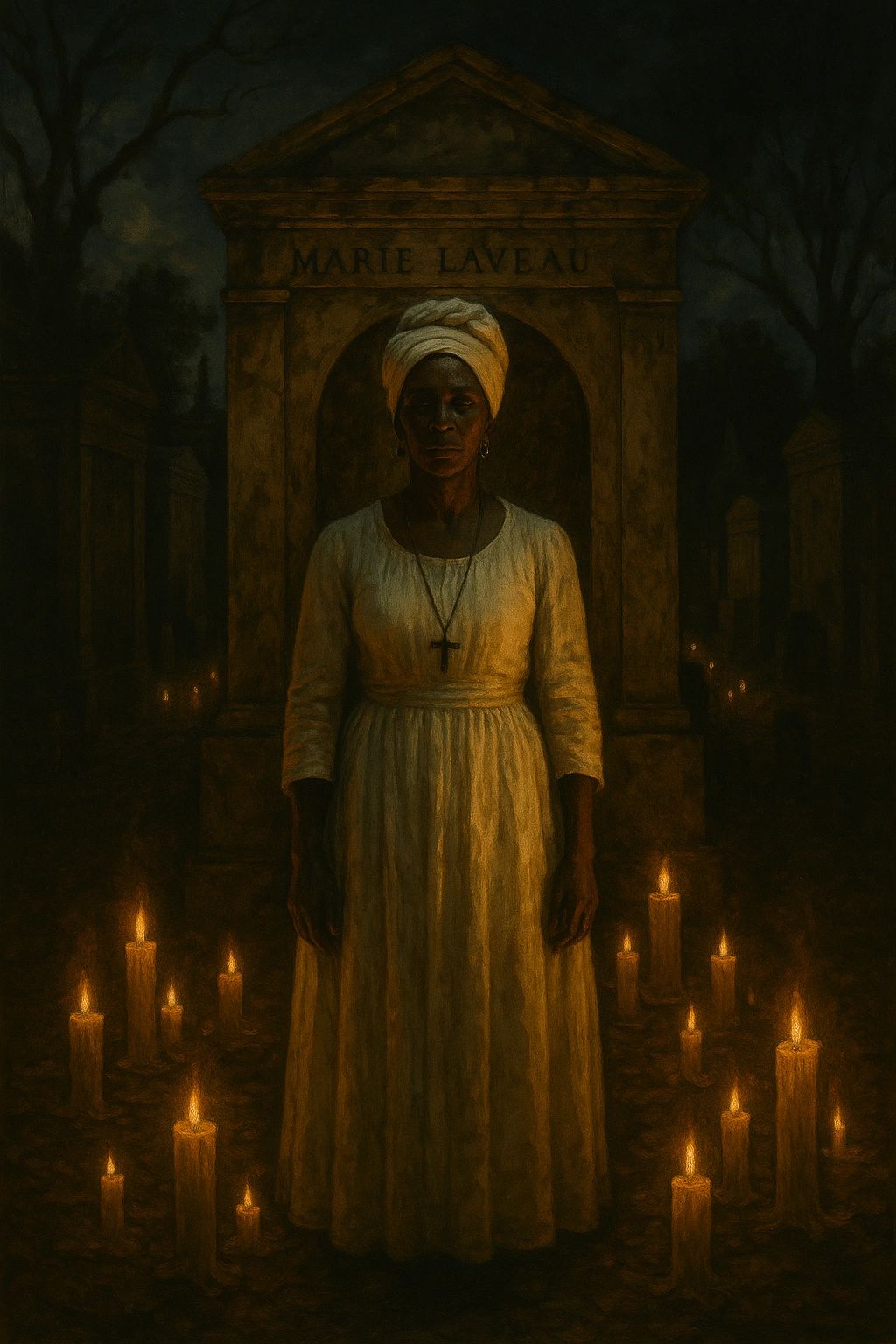
Marie Laveau became a central figure in these gatherings. Clad in white, her hair wrapped in a tignon (headscarf), she led ceremonies honoring the spirits. Her rituals included:
- Offerings of food, flowers, and rum.
- The lighting of candles and incense.
- The singing of sacred songs in Creole, French, and African languages.
- Dancing that built to trance states, allowing possession by the loa.
To outsiders, these ceremonies seemed wild, even frightening. Rumors spread of snake worship, orgies, and devilry—fantastical tales that reflected fear and racism more than truth.
In reality, Marie Laveau’s ceremonies were deeply spiritual acts of healing, empowerment, and community. They gave her people a sense of connection and control in a world designed to strip them of both.
The Magic and the Myth
Marie Laveau’s reputation for supernatural power grew with each passing year.
It was said that she could curse enemies, predict the future, and intercede with the spirits to bring about miracles. One famous story tells of a man on trial for murder. His family begged Marie for help. On the day of his hearing, she appeared at St. Louis Cathedral, prayed aloud, and placed three mysterious peppers under the judge’s bench. The next day, the man was inexplicably acquitted.
Another tale recounts how she helped lovers find fidelity—or punished the unfaithful—with small gris-gris bags filled with hair, herbs, and bones.
To some, she was a living saint, invoking both Jesus and the loa in her prayers. To others, she was the devil’s consort. But Marie herself always identified as a devout Catholic, attending Mass daily and encouraging her followers to blend Voodoo and Catholicism as one harmonious faith.
Even the Catholic Church couldn’t ignore her influence. While priests denounced her “pagan” practices, many parishioners secretly visited her for blessings and protection.
It was this duality—faith and fear, saint and sorceress—that made her legend endure.
The Second Marie Laveau: The Daughter and the Doppelgänger
After Marie Laveau’s death—or supposed death—in 1881, the legends only multiplied.
Some claimed to see her walking the streets long after her burial at St. Louis Cemetery No. 1, her tignon glinting in the sunlight, her eyes burning with power. Others said she never died at all—that she had learned the secret to eternal life from the spirits she served.
In truth, Marie Laveau II, her daughter, carried on her mother’s legacy. Equally beautiful and charismatic, the younger Laveau performed Voodoo ceremonies along Lake Pontchartrain and led public rituals that scandalized and fascinated white society.
The two Maries—mother and daughter—blurred together in memory and myth until no one could tell where history ended and the supernatural began.
St. Louis Cemetery No. 1: The Queen’s Eternal Rest
Today, pilgrims still visit Marie Laveau’s tomb in St. Louis Cemetery No. 1, one of the oldest and most famous graveyards in America. Her crypt is a whitewashed family tomb adorned with offerings: candles, coins, beads, and notes asking for help from beyond.
Tradition once held that if you marked three Xs (XXX) on her tomb, turned around three times, and left an offering, your wish would be granted. The city has since banned this practice due to damage to the tomb—but many still leave tributes, whisper prayers, and claim to feel her presence watching.
Tour guides tell of strange phenomena:
- Visitors fainting or feeling overcome with emotion.
- Candles lighting themselves.
- Soft laughter echoing through the rows of graves.
Whether you believe or not, the air around her tomb hums with energy. Marie Laveau remains a symbol of power, resistance, and spiritual mystery—a queen who still reigns in death.
Voodoo Today: Misunderstood and Reclaimed
Modern-day New Orleans Voodoo has evolved but endures. Practitioners continue to honor the loa, blending traditional African rites with Catholic prayer. The Voodoo Spiritual Temple on North Rampart Street, founded by Priestess Miriam Chamani, carries on the faith with dignity and respect.
Unfortunately, Hollywood and tourism often distort Voodoo into caricature—zombies, curses, and evil dolls. Real practitioners stress that Voodoo is not about harm or control, but about healing, balance, and connection with the ancestors.
Marie Laveau’s name, however, has never faded. She’s invoked in songs, films, and TV shows—from American Horror Story: Coven to novels and folk tales. In each retelling, she is many things: healer, witch, mother, queen, saint.
Her true legacy lies in her ability to bridge worlds—between Black and white, faith and magic, life and death.
The Power of Belief
What makes Marie Laveau’s story so enduring? Perhaps it’s that she represents the power of belief itself.
In a time when women of color were denied agency, she commanded respect from rich and poor alike. Her mastery of faith—both Catholic and Voodoo—allowed her to navigate two worlds, wielding power through charisma, mystery, and deep spiritual insight.
She was not merely a “witch” or a “sorceress.” She was a leader, a counselor, and a symbol of resilience. Her magic, whether literal or metaphorical, gave hope to the powerless and fear to those who oppressed them.
And that, perhaps, is the truest form of power.
The Enduring Legend
Even now, more than 140 years after her death, Marie Laveau’s spirit lingers in the humid New Orleans night. She is in the candles burning at roadside shrines. In the rhythmic drumbeats echoing through Congo Square. In the whispered prayers to the saints and the loa. In the hearts of those who still seek strength from her name.
Some claim to see her in shadowed doorways or feel her hand brush their shoulder during midnight walks through the Quarter. Others dream of her—wrapped in white, smiling knowingly, her eyes full of secrets.
Marie Laveau may have lived in the 19th century, but her legend belongs to every era. Because as long as New Orleans lives, the Queen of Voodoo lives too.
Bibliography
- Fandrich, Ina Johanna. The Mysterious Voodoo Queen, Marie Laveaux: A Study of Powerful Female Leadership in Nineteenth-Century New Orleans. Routledge, 2005.
- Long Carolyn Morrow. A New Orleans Voudou Priestess: The Legend and Reality of Marie Laveau. University Press of Florida, 2006.
- Hurston, Zora Neale. Tell My Horse: Voodoo and Life in Haiti and Jamaica. Harper Perennial, 1990.
- Tallant, Robert. Voodoo in New Orleans. Pelican Publishing, 1946.
- Hall, Gwendolyn Midlo. Africans in Colonial Louisiana: The Development of Afro-Creole Culture in the Eighteenth Century. LSU Press, 1992.
- Sublette, Ned. The World That Made New Orleans: From Spanish Silver to Congo Square. Lawrence Hill Books, 2008.
- Smith, Jessie Ruth. The Life and Times of Marie Laveau: The Voodoo Queen of New Orleans. Crescent City Press, 2012.
- Louisiana State Museum Archives. Exhibits on New Orleans Spiritual Practices and Voodoo Traditions.
- City of New Orleans Historical Society. Records of St. Louis Cemetery No. 1 and the Laveau Family Tomb.
About the Author
Rebecca “Madam Chronicler” Ryan is a writer and researcher for The Chronicler Library. She is the co-creator of The Chronicle of Fear and The Waterline Chronicles, and a lead researcher and contributor for The Captain’s War Chronicles and The Captain’s Cellar. Her work blends myth, history, and the natural world with empathy, insight, and intellectual rigor.
Originally published at the live site .