Folklore ·
Whispers in the Sugar Mill: The Haunting of Dunlawton Plantation
By nightfall, the ruins breathe again.
By Rebecca "Madam Chronicler" Ryan
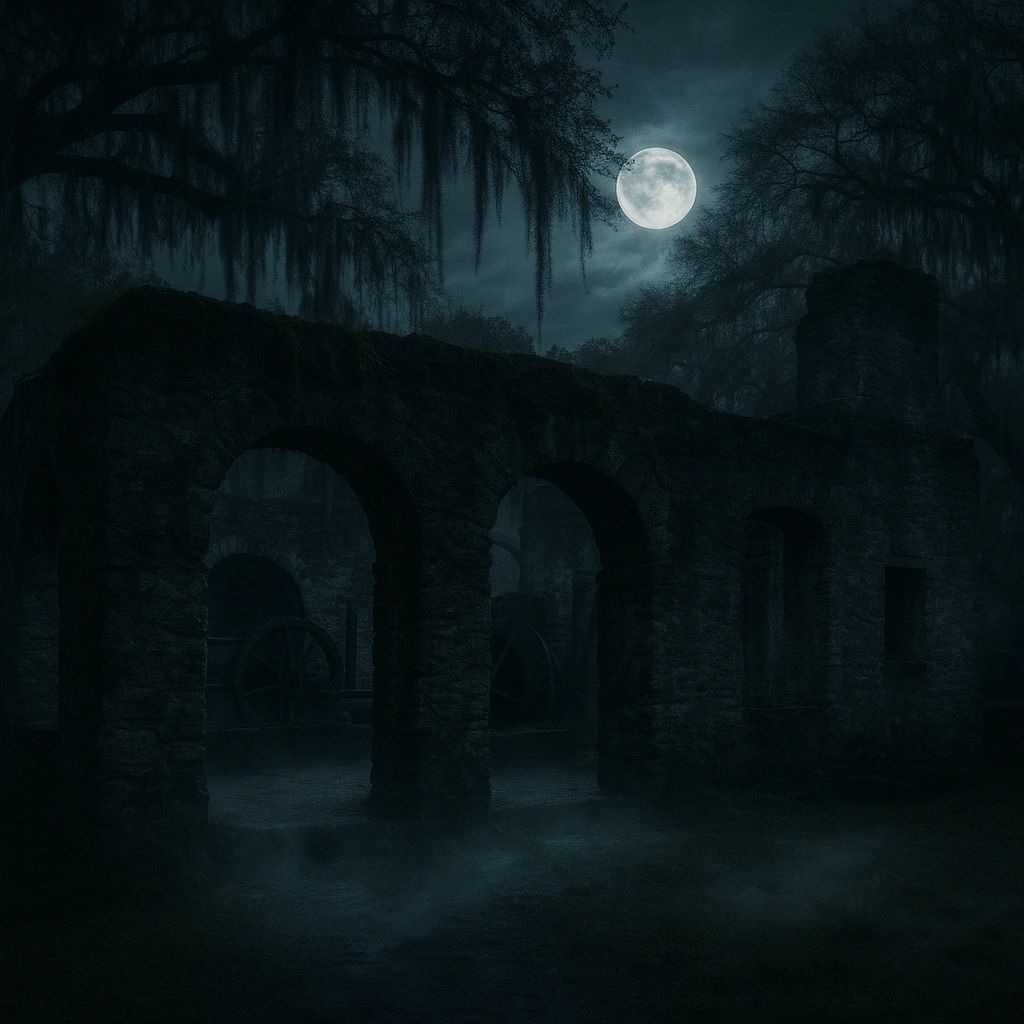
By nightfall, the ruins breathe again.
Prologue: The Road Beneath the Oaks
There’s a road in Port Orange, Florida, that winds beneath old live oaks whose branches stretch like arthritic arms over cracked pavement. Spanish moss sways gently from the limbs, brushing your windshield as you drive toward what the locals call the Sugar Mill Gardens. By day, the place seems harmless — lush greenery, chirping birds, children giggling near forgotten dinosaur statues.
But when the sun sinks low and the air grows thick, the land seems to remember.
It’s said that Dunlawton Plantation never forgot what it was built on — blood, sweat, and fire. Those who walk its paths at dusk sometimes hear it whisper: the crack of cane stalks breaking, the creak of iron gears, the soft hum of sorrow.
This is the story of Dunlawton — the plantation that refused to die.
Chapter One: The Land Before the Fire
Long before the sugar mill became ruins, this land was lush and quiet, a patchwork of marsh, pine, and fertile soil. In 1804, Spain still held Florida, and a Bahamian merchant named Patrick Dean secured a royal land grant of nearly a thousand acres along the Halifax River (Dunlawton Sugar Mill Gardens, History of the Site). He dreamed of prosperity — sugar, indigo, and rice — crops that could make a man rich.
Dean brought enslaved Africans to toil beneath the scorching sun. The mill’s rhythm became their prison: the endless cutting of cane, the boiling kettles, the sticky steam that coated their skin. They built the foundations — coquina stone walls and wooden beams that would one day outlast every living soul there.
Dean’s dreams were short-lived. He was murdered by Native Americans around 1818, and the plantation lay abandoned for years, its fields overtaken by weeds, its buildings collapsing into the earth (Volusia County Historical Society, 1985).
But Florida’s fertile soil tempts the ambitious. In 1830, Sarah Petty Anderson and her sons bought the property and named it Dunlawton — a merging of “Dunn” (Sarah’s maiden name) and “Lawton,” a family name from Charleston. They rebuilt what Dean had started.
The new sugar mill was a marvel — steam-powered iron rollers, boiling kettles, a furnace that never slept. Slaves labored from dawn to dark, their cries drowned by the hiss of boiling sugar and the rhythmic thump of cane being crushed.
If you stand there today, near the remains of the boiler room, you might still feel it — the heat, the pressure, the weight of invisible hands working through eternity.
Chapter Two: Fire on the Horizon
By 1835, war had come to Florida. The U.S. government, hungry for land, had pushed the Seminole people into smaller and smaller territories. When they resisted, the Second Seminole War erupted — and with it, the death of Dunlawton.
In December 1835, fires spread across the coast. Plantations were torched, fields burned, and the air was thick with smoke and panic. According to military reports, Dunlawton’s plantation house and slave quarters were already ablaze when militia forces under Major Benjamin Putnam arrived in January 1836 (Putnam Papers, Florida Archives).
The mill itself was left in ruins — the walls scorched, the machinery destroyed, and the enslaved workers scattered or dead.
Locals say that on still nights, you can smell smoke on the wind, even though the fires burned out nearly two centuries ago.
Visitors who wander too close to the furnace ruins sometimes describe a faint orange glow through the cracks of the coquina — a trick of light, perhaps, or something older smoldering beneath the surface.
The Anderson family never returned. Dunlawton, it seemed, was cursed to ruin.
Chapter Three: The Ghosts of Industry
The land lay fallow for years, haunted by its silence. Then came John J. Marshall, a man with ambition to match the swamp’s persistence. He bought Dunlawton in 1846, rebuilt the mill, and installed new machinery salvaged from a destroyed mill in New Smyrna (Dunlawton Sugar Mill Gardens Historical Marker, HMDB.org).
By 1851, the mill was producing 200 tons of sugar — a small fortune in those days. The clang of metal and hum of labor returned, but the ghosts of the past didn’t rest easy.
Workers whispered of strange happenings — voices echoing from the furnace when no one was there, shadows slipping between the gears. One overseer reportedly quit after seeing “a figure standing in the boiling room, skin pale and eyes like fireflies,” only for it to vanish when he shouted.
Then, in the 1850s, disaster struck again. The sugar market collapsed, and the cost of repairs mounted. Marshall abandoned the property. Once more, the mill fell silent, its gears stiffening in the humidity.
By the time the Civil War reached Florida, Dunlawton was a hollow shell. Confederate soldiers camped under its sprawling oaks, using the iron kettles to make salt from seawater (Florida State Archives, Confederate Correspondence, 1862). They called the largest tree The Confederate Oak.
After the war, the site was forgotten again — a graveyard of industry where moss crept over history and silence reclaimed the land.
Chapter Four: Bongoland — The Strange Resurrection
It might have ended there — just another ruin lost to time — but Dunlawton has a habit of being reborn in the strangest ways.
In 1948, a doctor named Perry Sperber leased the property and turned it into something straight out of a fever dream. He called it Bongoland.
Visitors could see life-sized concrete dinosaurs, ride a miniature train, and visit “Bongo,” a live baboon mascot (Daytona Beach Historical Society, Oral History Interviews, 1974). The long-dead plantation became a roadside attraction, its dark past buried beneath kitsch and laughter.
But even Bongoland couldn’t shake the curse. Employees claimed that some mornings the park gates were open when they’d been locked the night before. Dinosaur figures were found toppled, and the sound of footsteps echoed in the empty sugar mill.
Local legend says that Dr. Sperber once tried to spend a night in the ruins — only to flee before dawn, pale and shaken. He later told a friend, “It’s not the dinosaurs that move at night — it’s the walls.”
Bongoland closed in 1952. The laughter faded. The ghosts remained.
Chapter Five: Gardens Among the Graves
In the 1980s, the Botanical Gardens of Volusia, Inc. took over the land. They cleaned the rubble, built walking paths, and restored the site as a nature sanctuary. The dinosaurs were left as relics — silent sentinels over the ruins.
Now called the Dunlawton Sugar Mill Gardens, it’s a place of contradictions: sunlight filters through palm fronds onto rusting iron; wildflowers bloom beside collapsed walls. Children play where slaves once toiled.
But some visitors sense more than peace.
According to local paranormal groups, strange activity still occurs:
- Whispers near the old boiling room when the gardens are empty.
- Shadows crossing the path though no one walks there.
- The smell of molasses and smoke drifting suddenly through the air.
- A low hum, like gears turning somewhere deep in the earth.
The Paranormal Ghost Society documented the site in 2007, describing it as “active with residual energy — footsteps, cold spots, and muffled voices carried by the wind” (ParanormalGhostSociety.org).
One volunteer gardener claimed to see “a man in old work clothes, head down, walking the cane rows that aren’t there anymore.” When she called out, he vanished — but the faint sound of scraping metal continued, as if a blade were still cutting sugarcane.
Chapter Six: Echoes of the Past
Why does Dunlawton linger? Perhaps because its story was never fully told.
Beneath its roots are centuries of conflict and pain:
- The displacement of the Seminole.
- The lives of enslaved men and women who built and bled for the plantation.
- The soldiers who camped beneath the oaks.
- The workers who rebuilt and failed again.
- The children who played in Bongoland, laughing in the shadow of forgotten suffering.
Every phase of Dunlawton layered another ghost upon the soil.
Even the air feels heavy here, as if history presses down like the Florida humidity. The ruins are not merely broken walls — they are bones, holding the shape of all that once was.
Chapter Seven: The Visitor
One evening in late October, a local historian named Eleanor Tate decided to visit Dunlawton after hours. She was writing a book about haunted plantations and wanted firsthand impressions.
The gate was closed, but she slipped through a gap in the fence and followed the path lit faintly by moonlight. The air was thick, the smell of wet stone and earth rising around her.
She stopped at the boiler room. Its coquina walls glimmered, damp and silver under the moon. Somewhere in the distance, a tree frog chirped. Then, from the darkness, came another sound — rhythmic, metallic. A steady clank…clank…clank.
Eleanor froze. The old gears of the mill, long rusted and still, seemed to stir again. The air grew warm — impossibly warm.
She heard voices, low and muffled, like men grunting as they heaved cane into rollers. Then came a woman’s cry — faint, desperate, carried on the wind.
When Eleanor turned toward the noise, she saw only empty stone.
But pressed into the mud at her feet were fresh footprints — large, bare, leading straight into the ruins and stopping at the furnace wall.
She fled before dawn. Later, when she returned with a ranger, the footprints were gone.
She swore she’d never go back. Yet her book — “The Living Shadows of Dunlawton” — became a cult classic among Florida ghost stories. In it, she wrote one final line that lingers in memory:
“They are still there, working. They never stopped. The sugar never stopped boiling.”
Chapter Eight: The Haunting as History
What makes Dunlawton’s haunting so potent isn’t just ghostly figures or flickering lights — it’s the way memory refuses to die here. The ruin itself is the haunting.
You can touch the coquina blocks and feel the heat of lost centuries. The grooves in the stone mark where enslaved hands once placed timber beams. The moss that climbs the walls is the same green that once shadowed fields of sugarcane.
Even the dinosaur statues, now cracked and fading, feel like ghosts of another kind — reminders of how easily humans bury truth beneath spectacle.
Dunlawton teaches us that ghosts aren’t always spirits. Sometimes, they’re memories that refuse to rest.
Epilogue: Listen to the Stones
If you visit Dunlawton today, you’ll find families picnicking under oaks, couples taking wedding photos near the ruins, volunteers tending flowerbeds.
But pause for a moment at dusk. Let the wind move through the trees.
Listen closely.
There’s a rhythm in the air — the faint grind of gears, the soft sigh of sugar boiling. It rises and falls with the cicadas.
Maybe it’s imagination. Maybe it’s history breathing.
Or maybe it’s Dunlawton itself — a place that lived too many lives to ever truly die, whispering through its ruins:
“Remember us.”
Bibliography
Primary Sources
- Putnam, Benjamin A. Military Correspondence during the Second Seminole War, 1835–1836. Florida State Archives, Tallahassee.
- Florida Confederate Records, 1862–1865. Confederate Army Operations in Volusia County. State Library and Archives of Florida.
- Dunlawton Sugar Mill Historical Marker Series. Historical Marker Database (HMDB.org). Accessed 2025.
- Dunlawton Sugar Mill Gardens Official Site. “History of the Site.” https://www.dunlawtonsugarmillgardens.org/about.html
- Volusia County Historical Society. Records of Early Plantations in East Florida. Daytona Beach, 1985.
Secondary and Interpretive Sources
- “Dunlawton Plantation and Sugar Mill Ruins.” Wikipedia, last updated 2024. https://en.wikipedia.org/wiki/Dunlawton_Plantation_and_Sugar_Mill
- “The Haunted Librarian: Dunlawton Sugar Mill.” TheHauntedLibrarian.com. Accessed November 2025.
- “Dunlawton Sugar Mill Gardens.” Florida Backroads Travel. Accessed 2025. https://www.florida-backroads-travel.com/dunlawton-sugar-mill-gardens.html
- Paranormal Ghost Society. “Investigation: Dunlawton Sugar Mill Gardens.” https://paranormalghostsociety.org/Dunlawton%20Sugar%20Mill%20Gardens.htm
- Abandoned in 360. “Dunlawton Sugar Mill Gardens.” https://abandonedin360.com/abandoned-commercial-properties/dunlawton-sugar-mill
- Daytona Beach Historical Society Oral History Collection, Interview with Dr. Perry Sperber, 1974.
About the Author
Rebecca “Madam Chronicler” Ryan is a writer and researcher for The Chronicler Library. She is the co-creator of The Chronicle of Fear and The Waterline Chronicles, and a lead researcher and contributor for The Captain’s War Chronicles and The Captain’s Cellar. Her work blends myth, history, and the natural world with empathy, insight, and intellectual rigor.
Originally published at the live site .